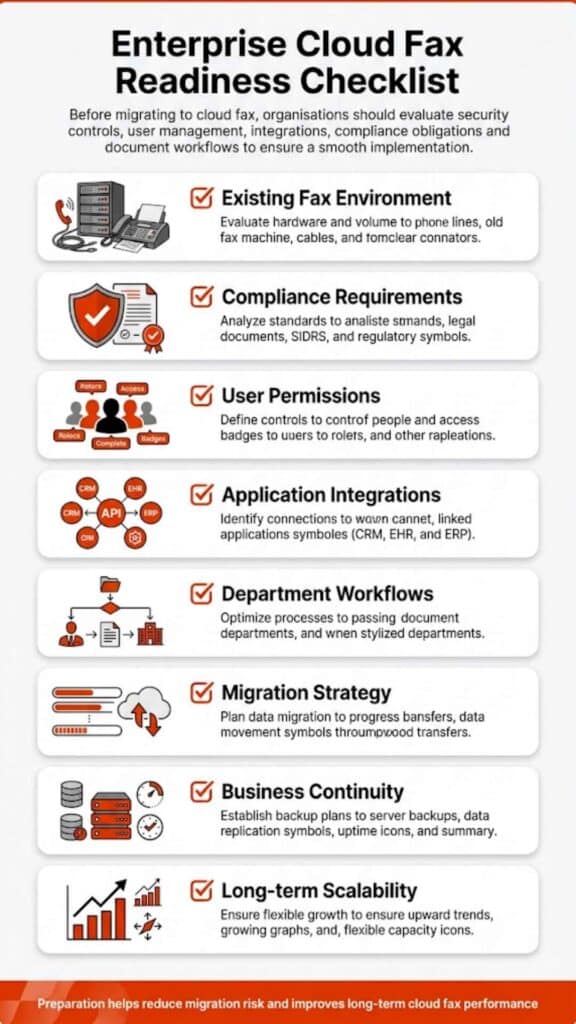
Can I Use My Existing Fax Number With a Cloud Fax Service?

Yes, in many cases, you can use your existing fax number with a cloud fax service. The usual path is number porting, which lets you move the number from a legacy fax line or landline setup to an online fax service without changing the digits your customers, referral partners, and staff already know. 

The catch is that port approval depends on accurate carrier records, an active line, and a clean porting request. And one rule matters more than most: do not cancel your current fax service before the port is complete, because FCC guidance warns that early termination can disrupt the transfer process.

When businesses ask, Can I use my existing fax number with a cloud fax service?, they are usually asking two things at once. First, can the number stay the same? Second, will the switch break the workflow that keeps documents moving every day? 

For most U.S. businesses, the short answer is yes, an existing fax number can often be retained by porting it to a cloud fax provider. But here’s the problem: a number port is not just a formality. It is a carrier-level process tied to account data, service eligibility, and timing. If any of those pieces are off, the move can stall.

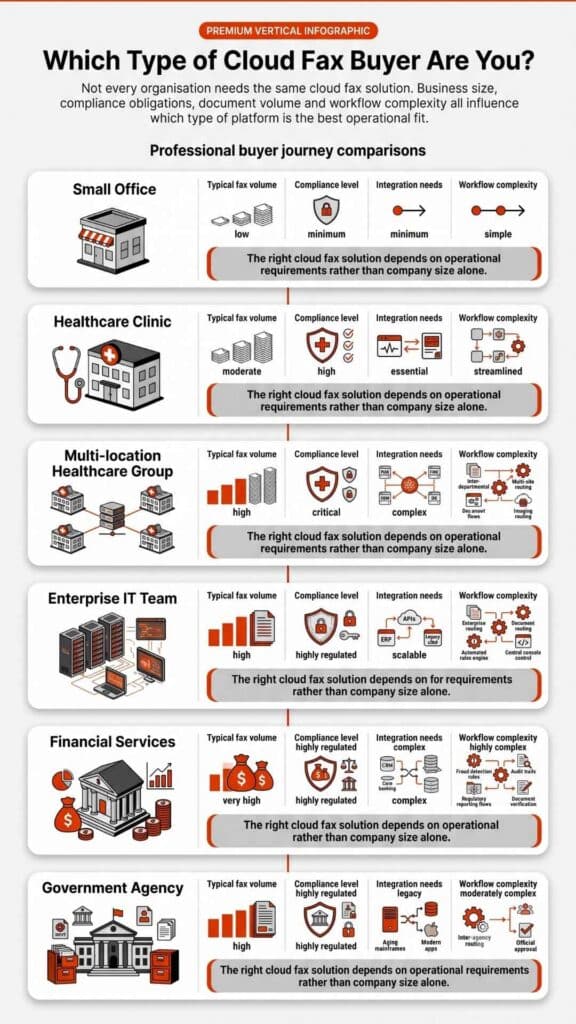
That is exactly why this topic matters more in healthcare, finance, insurance, government, and other document-heavy sectors. A fax number is not just a line on a business card. It may already be part of referral workflows, EHR templates, intake forms, directories, and established partner records. Softlinx positions its cloud fax platform around those business needs, with support for healthcare IT providers, enterprises, software vendors, secure document exchange, EHR integration, email to fax, web portal faxing, and HIPAA-aligned workflows.

Can I use my existing fax number with a cloud fax service?

Yes, in many situations, you can use your existing fax number with a cloud fax service by submitting a number porting request through the new provider. FCC guidance says customers who switch providers and remain in the same geographic area can generally keep their existing number, and the FCC also warns customers not to terminate service with the old provider before the new service is in place. That same logic applies when a business moves a fax line from a traditional setup to a digital fax service or online fax service.

That said, can I use my existing fax number with a cloud fax service? does not always have a blanket yes attached to it. Some numbers are easy to port. Others get delayed because the business name does not match the carrier record, the line was canceled too early, the account number is wrong, or the number sits in a rate-center setup that the new provider cannot support. So the better answer is this: in many cases, yes, but only if the porting process is handled carefully and the provider has a dependable process for validation, coordination, and cutover.

What number porting really means for your fax line

A lot of people still think the fax number lives with the fax machine. It does not. The number is tied to the telephone carrier record, not the hardware itself. That is why businesses can move from a fax machine and landline to a cloud fax platform while keeping the same fax number. The device changes. The number often does not.

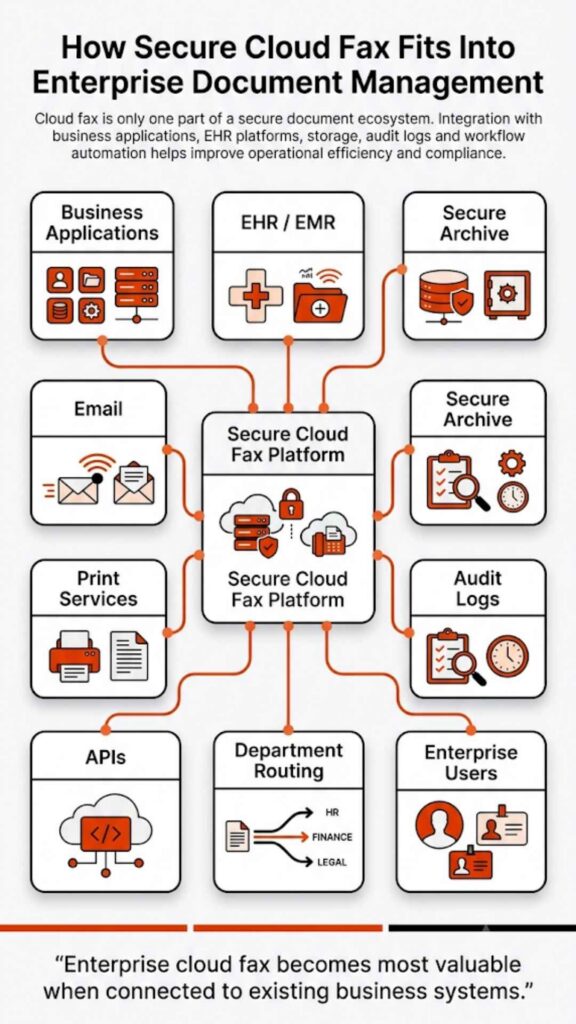
So here’s how it works. Your new provider submits a porting request to take control of the number. Once the transfer is approved and completed, the number routes through the new cloud fax service instead of the old fax line. After that, your team can usually manage fax traffic through a browser, email workflow, API, mobile device, or application integration rather than a stand-alone fax machine. Softlinx’s platform, for example, supports web portal faxing, email to fax, print to fax, and integration-driven workflows designed for enterprise operations and healthcare environments.

When a port usually works, and when it can hit a wall

Most ports go through when the number is active, the business stays within the relevant geographic framework, and the submitted account details match the current carrier record. That is the clean version. The messy version is more common than many provider pages admit. A porting request can fail or slow down if the authorized contact is incorrect, the billing address is outdated, the line has a carrier freeze, or account changes are made midway through the request.

Businesses moving from a legacy landline, fax server, or analog fax machine should be especially careful. If the fax number is bundled with a broader telephone service package, a careless port request can affect more than the fax line. If someone cancels service before the number porting is complete, the number may no longer be eligible for transfer. That one mistake causes a lot of unnecessary pain.

Fax setupCan the number usually be ported?What to verify first
Stand-alone business fax lineOften yesActive status, account number, service address
Fax number tied to a landlineOften yes, but may need extra reviewWhether other services are attached to the line
Multi-line business accountOften yes, though slowerAuthorized contact, cutover timing, and carrier records
Disconnected fax numberOften noWhether the carrier can restore the line first
Legacy fax machine with analog lineOften yesWhether the new provider supports that number’s location

This is why the question is not only about whether a number can move. It is really a question about eligibility, documentation, timing, and how well the new provider manages business continuity during the transition.
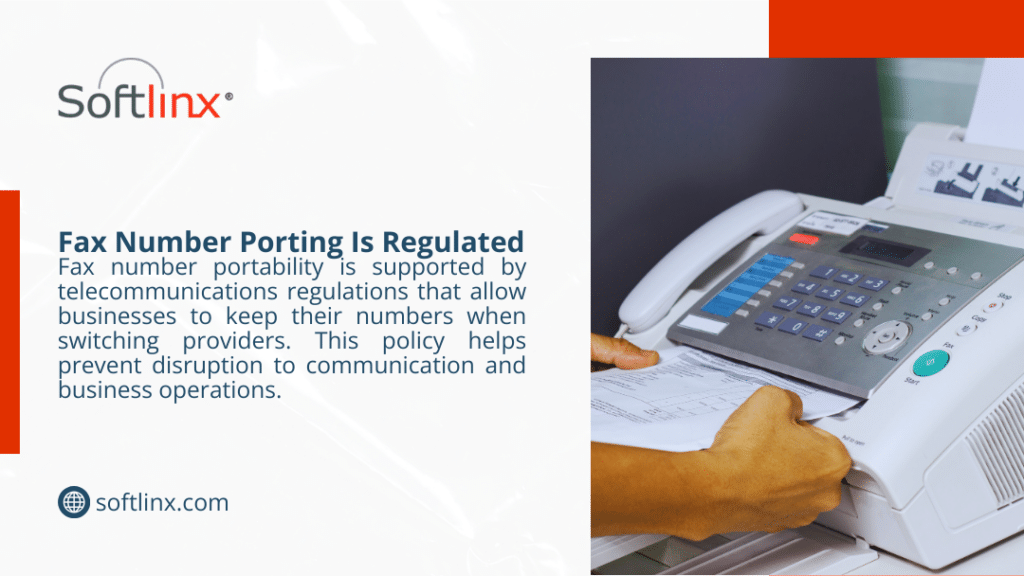
Person feeding a document into a fax machine, illustrating how fax number porting is regulated to protect businesses switching providers.

What you need before you submit a porting request

Most providers ask for the same core details. They typically need a signed authorization, the current provider name, the fax number to be ported, the account number, and the exact billing or service address on file. The typical process involves signing up for the service, reviewing the authorization document, and, in some cases, receiving a temporary fax number while the transfer is in progress.

The exact paperwork varies a bit, but the principle stays the same. The new provider needs enough information to prove you control the number and to ask the old provider to release it. If anything is off by even a small margin, the request can bounce back. That is why businesses should pull a recent invoice and use the account data exactly as the current carrier has it on record. This is one of the most common reasons number ports are delayed.

Document or detailWhy it mattersCommon issue
Signed porting authorizationLet the new provider act on your behalfMissing signature or wrong signer
Recent bill copyConfirms account and service detailsOutdated or incomplete invoice
Exact business name on recordMust match the carrier databaseTrade name used instead of legal name
Service addressValidates ownership and locationOld office address still on file
Account numberIdentifies the current serviceEntered incorrectly or omitted

How the porting process usually unfolds

First, the business opens the new cloud fax service account. Next comes the porting request, with the supporting records attached. Then the new provider sends the request to the current carrier. If the old carrier approves it, both sides coordinate a cutover date. During the transition period, some vendors may provide a temporary fax number so teams can begin sending faxes immediately, while incoming faxes continue to arrive on the existing line until the porting process is fully completed.

In practical terms, that means your team can start testing the new online fax service before the permanent fax number fully lands there. That helps a lot. It lets staff learn the new workflow, check user permissions, confirm email-to-fax behavior, and verify whether inbound documents are routing to the right inboxes or folders. If your business relies on cloud fax or needs to fax through the internet, that overlap period can reduce risk during the move. That kind of controlled transition matters far more to business users than a simple promise that porting is easy.

How long does number porting take?

FCC material says simple ports have specific timing rules, but real-world business ports are not always simple. A single-line transfer with clean records is usually faster than a port tied to a larger business telephone setup, a bundled service, or multiple lines. The FCC’s own consumer guidance notes that simple ports are governed by FCC rules, while the old and new providers coordinate the actual move.

So here’s what happened in the market: fax service providers often describe number porting as quick and straightforward, and in some cases, it can be. But business buyers should still expect variance. A clean request may move without much drama. A messy one can drag because one detail in the record does not match. That is why the safest planning approach is not to promise a rigid deadline internally until the new provider confirms it. For organizations with shared workflows, compliance requirements, or multiple departments, realistic planning is more valuable than optimistic estimates.

The mistakes that delay ports most often

The biggest issue is bad data. A billing address mismatch, a wrong account number, or a signer who is not authorized can stop the process cold. Early cancellation is another one. The FCC explicitly warns against terminating service before the new service is established, and other provider guidance says the same thing in plain terms: never cancel before the port completes.

There is also the internal side of the problem. Teams sometimes update stationery, directories, contact records, or workflow rules before the port is finished. That creates confusion if the number does not move on the expected date. The cleaner route is to treat number porting like a controlled change, not a casual provider swap. If your business uses VoIP fax or is weighing whether to modernize from analog infrastructure to digital fax, planning matters just as much as the provider choice.

Delay triggerWhat causes itHow to avoid it
Account mismatchCarrier records and submitted data do not matchUse a recent bill and copy the details exactly
Service was canceled too earlyThe number becomes unavailable for transferKeep the old line active until completion
Wrong authorized contactCarrier rejects the requestUse a signer with account authority
Bundled services on the lineOther phone services complicate the releaseReview everything attached to the line first
No testing planProblems show up only after cutoverRun send/receive tests before and after port

What changes after the number moves to cloud fax

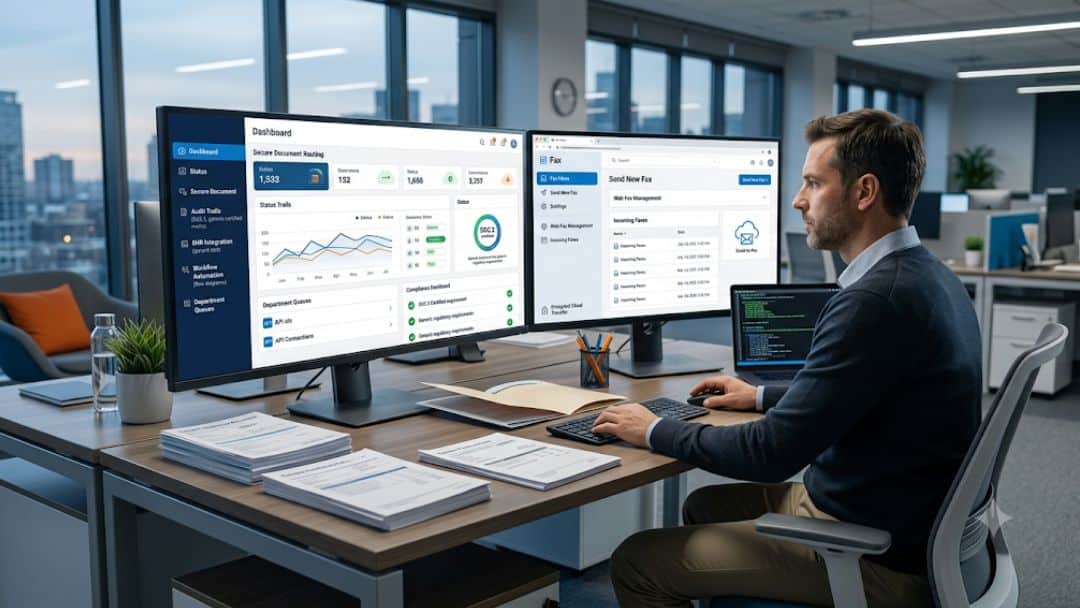
Once the fax number ports successfully, the number stays familiar, but the workflow changes quite a bit. Instead of standing by a fax machine, users usually send and receive through a browser, email inbox, mobile app, or integrated business application. That is the real operational value. A cloud fax service keeps the public-facing number stable while changing the back-end process into something easier to track, route, and secure.For many organizations, that also means the fax process can move closer to daily work instead of living off to the side. Staff can send from desktops, receive by email, or route documents into a workflow. Businesses that need to email to a fax number or want a stronger fax server alternative usually care less about the device and more about continuity, auditability, and convenience. That is where cloud fax becomes more than a hardware replacement. It becomes part of a broader document workflow strategy.
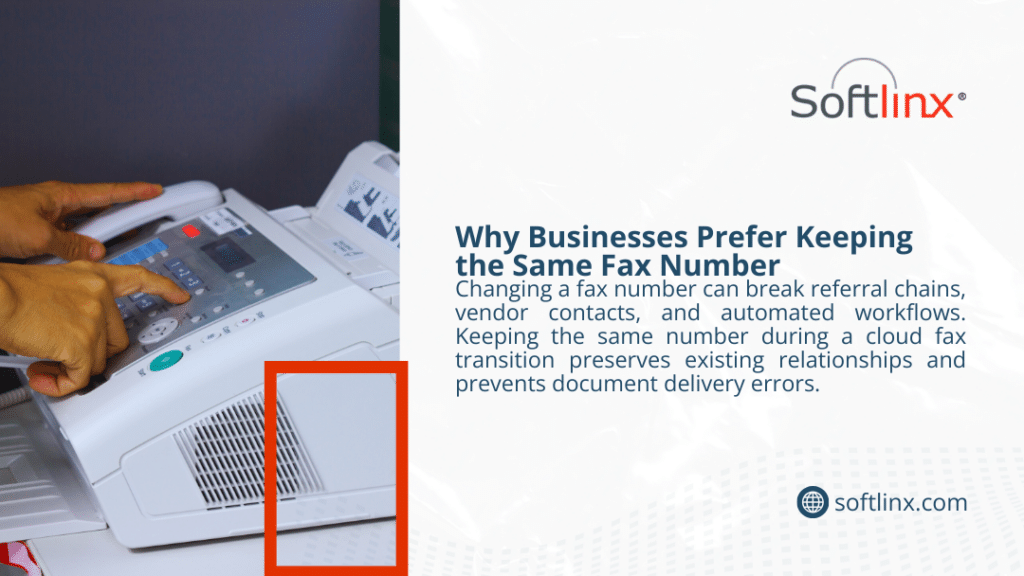
Hands operating a fax machine, illustrating why businesses prefer keeping the same fax number during a cloud fax transition.

Why this matters even more in healthcare

Healthcare has its own twist on this question. When a practice asks, can I use my existing fax number with a cloud fax service?, it is not just trying to preserve convenience. It is trying to avoid disruption to referrals, records exchange, orders, authorizations, and care coordination.

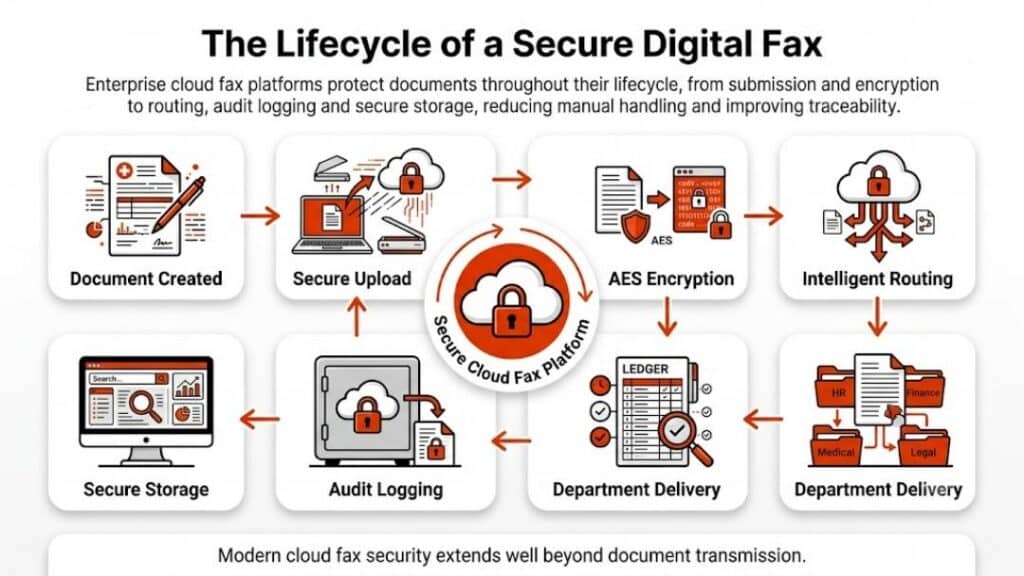
The HHS HIPAA Security Rule says electronic protected health information must be protected with administrative, physical, and technical safeguards. That does not mean every cloud fax product is automatically appropriate. It means the provider and the workflow both need to support those safeguards. 

For healthcare organizations, keeping the number is only one part of the decision. The larger issue is whether the service can support secure document delivery, access controls, auditability, and dependable routing.

That is one reason healthcare still leans on fax more than many outsiders expect. An ASTP/ONC Quick Stat updated in February 2026 shows hospitals still often or sometimes use mail or fax to exchange health information. In 2025, 40% of hospitals reported they often used mail or fax to send information, and 35% said they often used it to receive information; another 34% said they sometimes used it to send, and 46% said they sometimes used it to receive. So yes, digital exchange is rising, but fax remains part of real clinical operations.

That makes the cloud fax move less about replacing communication and more about modernizing it. Softlinx leans into that angle by emphasizing secure transmission, audit trails, BAA support, encryption, and EHR integration with healthcare systems such as Epic, Cerner, and Allscripts. 

If a healthcare organization is evaluating HIPAA fax, whether fax is HIPAA compliant, or HIPAA-compliant fax services, the number port is only one part of the decision. The larger issue is whether the new system protects PHI and fits the clinical workflow.

EHR workflows, continuity, and the hidden cost of switching badly

A fax number may already be embedded in EHR templates, contact directories, referral instructions, and medical records processes. If the number changes, someone must update all of that. If the number stays the same, the change is much easier to absorb. That is why many healthcare buyers ask whether they can keep their current fax number when moving to cloud fax before they ask almost anything else. Keeping the number can reduce operational friction during the switch.That is also where integration matters. Softlinx positions its platform for EHR integration and offers content around how to connect fax to EHR and how to prevent HIPAA violations when faxing medical records. For a medical office, hospital, or clinic, the goal is not merely to keep sending faxes. The goal is to keep documents moving without losing visibility, accountability, or control.
Hands holding a tablet with floating digital data icons, illustrating how cloud fax improves document tracking with logs and searchable archives.

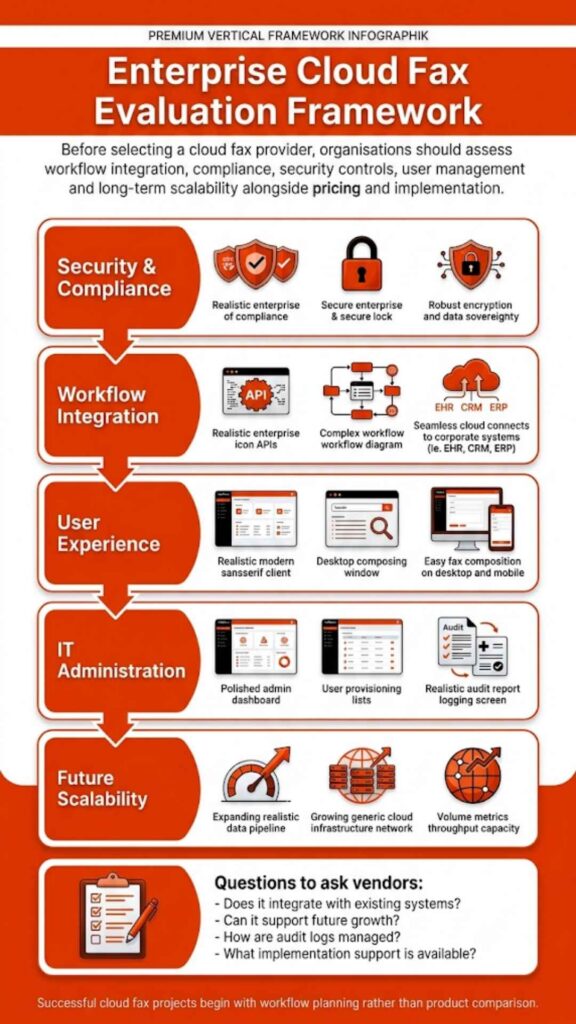
What businesses should check before they switch

Before a business ports a number, it should confirm who owns the line, which services are attached to it, what the exact billing record says, and how inbound fax traffic will be handled during the transition. It should also test what the new platform will feel like after cutover. Can users send from email? Can they send from a browser? Can the team receive documents securely on multiple devices? Can admins track activity? Those questions matter more than marketing promises.

For healthcare organizations, one more layer belongs in the review: whether the service supports a business associate agreement, audit trails, encryption, and practical controls around user access and routing. HHS makes clear that ePHI requires safeguards, and Softlinx’s healthcare content consistently emphasizes those operational controls rather than generic convenience claims. That makes the cloud fax decision part compliance issue, part workflow decision, and part migration project.

So, can you keep the number and lose the hassle?

Yes, in many cases, you can. That is the plain answer to can I use my existing fax number with a cloud fax service? But the better takeaway is this: number porting is not just about keeping digits. It is about preserving business continuity while replacing the old fax line, fax machine, or landline process with something more flexible and easier to manage. FCC guidance supports number portability in many cases, and healthcare guidance from HHS makes clear that the security side of the workflow matters just as much as the transport method.

For Softlinx, the strongest brand-safe message is straightforward. Businesses often can port an existing fax number to cloud fax, but they should choose a provider that can handle the transfer carefully, keep traffic moving during the change, and support the security and integration demands behind that number. 

That is the real differentiator: not simply offering online fax, but supporting a reliable transition, compliant workflows, and integration-ready document delivery for organizations that cannot afford disruption. If the goal is to keep the number, modernize the workflow, and reduce disruption, this can help you start in the right place: evaluate the porting process, review your current line records, and look closely at the broader benefits of cloud fax before making the move.

Security & Compliance

HIPAA-Compliant Since 1999 25+ years of secure, encrypted fax transmission for healthcare organizations.

HIPAA
PCI-DSS
Encrypted
Audit Trail
25+ Years Experience
100% HIPAA Compliant
Learn About Our Compliance

Industries We Serve

Healthcare Cloud Fax Solutions

Healthcare & Medical

Financial Services

Insurance Companies

Government Agencies

Manufacturing

Higher Education

Trusted by Fortune 1000 companies including State Street, IBM, HSBC, and United Nations.

Explore Industry Solutions

Why Choose Softlinx

No Hardware Required Eliminate costly fax servers and infrastructure. Cloud-based solution accessible anywhere, anytime.

Seamless Integration Easy API integration with your EHR, EMR, or business applications. Epic-certified integration available.

Enterprise Reliability 99.9% uptime SLA. No busy signals. Disaster recovery in real-time with automatic failover.

Superior Support U.S.-based technical support team. Dedicated account management for enterprise clients.

Cost Savings Reduce IT overhead by up to 60%. Pay only for what you use with flexible, scalable pricing.

Ready to Go Cloud?

Join healthcare leaders, financial institutions, and Fortune 1000 companies who trust Softlinx for secure, compliant faxing.

(978) 881-0560

Headquarters: 19321 US Highway 19 N, Suite 607
Clearwater, FL 33764 | help@softlinx.com

Trusted By Industry Leaders

"For over 25 years, Fortune 1000 companies and healthcare organizations have relied on Softlinx for mission-critical document transmission."

State Street
IBM
HSBC
Ericsson
Fannie Mae
United Nations
500+ Clients Worldwide
4.8★ Capterra Rating

Latest Articles By Softlinx

Office professional organizing incoming faxes efficiently using dual-monitor digital document management system for modern businesses.

How to Organize Incoming Faxes Efficiently (Complete Guide for Modern Businesses)

If incoming faxes feel scattered, delayed, or hard to track, the issue usually isn’t volume; it’s structure. This guide breaks down how to organize incoming faxes using real-world workflows, automation, and secure cloud systems, with a strong focus on healthcare and regulated industries where accuracy and compliance matter most.

How to Organize Incoming Faxes (Step-by-Step Framework)

Most teams don’t actually organize faxes. They react to them. A document comes in. Someone prints it. Maybe it gets handed off. Maybe it sits there for a while. Then someone asks, Did we receive that fax? and that’s where the trouble starts.

So here’s what I’ve seen work in real environments. Every reliable fax workflow follows a simple path. First, the fax arrives. Then it gets identified. After that, it’s routed. Finally, it’s stored somewhere people can actually find it later.

That sounds obvious, but the breakdown usually happens in the middle. Classification and routing are where things fall apart. That’s exactly why learning how to organize incoming faxes isn’t about folders; it’s about control.

What Is the Best Way to Organize Incoming Faxes?

The best way to organize incoming faxes isn’t a single tool or method. It’s a combination of structure, automation, and visibility. At a basic level, every fax should follow a defined path. It arrives, gets identified, moves automatically to the right destination, and is stored in a searchable format.

But in practice, the best way depends on how the system handles complexity. Here’s a simplified comparison:

ApproachOutcome
Manual handlingInconsistent and slow
Basic digital setupImproved storage, limited workflow
Automated cloud systemConsistent, scalable, and traceable

Modern organizations, especially in healthcare, tend to rely on automated cloud-based workflows. Not because they’re newer, but because they remove uncertainty.

What matters most is predictability. When every document follows the same process, teams don’t have to stop and think about what to do next. And that’s where organization truly starts to work.

Why Fax Organization Still Matters in 2026

You might expect fax to disappear by now. It hasn’t. In healthcare alone, 9 billion pages still move through fax systems every year. That’s not slowing down anytime soon. And here’s why.

Fax is still trusted for regulated communication. Especially when patient data is involved. If you’ve ever looked into HIPAA fax compliance, you’ll know the rules aren’t flexible.

So organization isn’t just about efficiency. It’s about staying compliant, avoiding exposure, and making sure information lands exactly where it should. And that’s why it matters.

Common Problems with Incoming Fax Management

If you walk into most offices, the problems look familiar. Documents go missing. Not permanently, but long enough to cause issues. Sometimes they’re sitting on a machine. Sometimes they’re scanned but never routed. Sometimes they land in the wrong department entirely.

Then there’s a delay. A fax comes in at 9 a.m. but doesn’t get processed until the afternoon. Multiply that across dozens of documents, and it adds up quickly. Security is another concern. If a document contains sensitive data and sits unattended, that’s already a risk.

Most of these issues come back to one thing. No clear system for how to organize incoming faxes.

Manual vs Digital Fax Organization Systems

There’s a noticeable gap between older methods and newer ones. It shows up in speed, accuracy, and how easy it is to scale.

MethodSpeedAccuracyScalabilityCompliance
Paper-basedSlowInconsistentLimitedRisk-prone
Fax serverModerateBetterModerateControlled
Cloud faxFastHighStrongSecure

A traditional fax server gives more control than paper, but it still needs maintenance. A cloud fax system shifts everything into a centralized environment where documents can be tracked and managed without physical limitations.

Traditional Methods to Organize Incoming Faxes

Even now, some organizations still depend on physical workflows. Not because they prefer them, but because that’s what has always been in place. If you look closely, most manual systems follow a few recognizable patterns.

One common method involves time-based sorting, where incoming faxes are grouped by date and time, then distributed later in batches. Another approach uses department trays, where each unit, billing, referrals, and administration, has a designated inbox.

There’s also the logbook method, where every fax gets recorded before it moves anywhere else. This creates a paper trail, but it slows things down. To make it clearer, here’s how these methods typically operate in practice:

Method TypeHow It WorksWhere It Breaks Down
Time-based sortingFaxes are grouped and processed in batchesDelays build quickly
Department traysDocuments are manually placed per teamMisplacement risk
Logbook trackingEntries recorded before routingTime-consuming
Individual handlingStaff distribute faxes directlyNo consistency

The issue isn’t that these methods don’t work. They do at low volume. But once activity increases, the cracks start to show. That’s usually when teams begin searching for better ways to handle how to organize incoming faxes without relying on manual steps.

Office worker manually sorting fax documents taking 5–15 minutes each, compared to seconds with automated fax processing systems.

Digital Fax Management Systems Explained

Digital fax systems don’t just replace paper. They change how documents move entirely. Instead of receiving a fax and deciding what to do next, the system already knows.

Faxes arrive directly into a centralized interface. That could be a browser portal, an email inbox, or a connected application. From there, documents become immediately visible, not just to one person, but to the right people.

One detail that often gets overlooked is indexing. Digital systems don’t just store documents; they tag them. Sender details, timestamps, and even content identifiers allow teams to search instead of sift.

That’s a major shift. In many environments, especially healthcare, teams rely on fax through the internet because it removes physical bottlenecks entirely. No machine. No waiting. No dependency on location.

Another advantage is audit visibility. Every action leaves a trace. That matters when accountability is required. So while traditional systems depend on memory and manual effort, digital systems rely on structure and traceability.

Automating Routing of Incoming Faxes

Routing is where most workflows either hold together or fall apart. In a manual setup, someone has to decide where each fax goes. That decision gets repeated dozens, sometimes hundreds of times per day. It’s not sustainable.

Automation changes that. Instead of reacting to each document, rules are set in advance. These rules can be simple, like sending all lab results to one department. Or more refined, such as identifying specific providers, document types, or keywords.

In more advanced setups, routing becomes layered. A document might first be categorized, then prioritized, then assigned. To understand how structured routing works in real environments, automating incoming fax routing demonstrates how incoming documents can be directed automatically based on predefined rules, improving efficiency and reducing manual handling.

What stands out isn’t just speed, it’s predictability. Every fax follows a defined path. No guesswork involved.

How Fax Automation Improves Organization

Once automation is active, the workflow starts to feel different. There’s less waiting. Less checking. Fewer follow-ups asking where a document ended up.

What actually improves is flow. Documents move continuously instead of sitting in queues. Teams don’t need to monitor intake constantly because the system handles distribution. And errors, while never eliminated, become far less frequent.

Another aspect worth mentioning is consistency. Manual workflows depend on people remembering steps. Automated systems don’t forget. This is where fax automation stops being an upgrade and becomes part of the foundation.

It also supports accountability. When something goes wrong, you can trace exactly where the process broke.

Organizing High-Volume Fax Workflows (Healthcare & Enterprise)

High-volume environments operate under different conditions. In healthcare, for example, incoming faxes don’t arrive evenly. There are spikes. Morning surges. End-of-day backlogs. Without structure, those patterns create bottlenecks.

That’s why systems designed for handling high-volume fax workflows rely on separation. Not all faxes are treated the same. Urgent referrals move immediately. Routine updates follow standard queues. Administrative documents can wait without affecting patient care.

Queue visibility becomes important here. Teams need to see what’s pending, what’s processed, and what requires attention. Without that visibility, volume turns into noise.

Integrating Fax with Business Systems

At a certain point, organization alone isn’t enough. Systems need to connect. When fax workflows remain isolated, teams end up re-entering information manually. That introduces delays and increases the chance of error.

Integration removes that gap. When a fax arrives, it can flow directly into an internal system, such as an EHR, without manual input. That means data moves once, not twice.

When connecting fax to EHR systems, organizations typically focus on how they approach integration in real settings. What changes isn’t just efficiency. Its reliability. Data stays consistent across systems.

Security and Compliance in Fax Organization

Security isn’t optional. Especially in healthcare. Understanding whether a fax is HIPAA compliant depends on how the system is set up. Encryption, access controls, and audit logs all play a role.

There’s also the human side. Processes need to be clear and consistently followed. Preventing HIPAA violations when faxing depends on reducing common errors, improving staff awareness, and ensuring that sensitive information is handled with proper safeguards at every step. An organization without security doesn’t hold up. Both need to work together.

Best Practices to Reduce Fax Errors and Improve Accuracy

Errors don’t usually come from complex issues. They come from small inconsistencies repeated over time. One practical approach is standardization. When documents follow the same naming and classification structure, they’re easier to track.

Another factor is verification. Confirming receipt and delivery reduces uncertainty. It sounds simple, but many workflows skip this step. Automation also plays a role here. Systems that flag incomplete or misrouted documents help teams catch issues early.

Organizations aiming to improve accuracy often adopt structured approaches similar to those used in reducing fax errors. It’s less about adding steps and more about removing unnecessary ones.

Transitioning from Fax Machines to Organized Cloud Systems

Moving away from fax machines doesn’t happen overnight. But once it starts, the benefits show quickly.

FeatureFax MachineCloud Fax
AccessibilityLimitedRemote
StoragePhysicalDigital
AutomationNoneAdvanced
IntegrationNoneFull

If you’re considering the shift, moving from fax machines to cloud fax highlights what to expect during the transition.

Misrouted fax labelled 'misplaced for billing' in office tray, showing how misrouted faxes disrupt healthcare and finance operations.

Key Features to Look for in a Fax Organization Solution

Not every system supports proper organization. Some only handle transmission. When evaluating solutions, a few capabilities tend to make the biggest difference.

FeatureWhy It Matters
Automated routingEnsures documents reach the right place
Centralized dashboardProvides visibility across all faxes
Audit trackingSupports compliance and accountability
Role-based accessControls who can view or manage documents
API integrationConnects fax workflows to business systems
High-volume handlingMaintains performance under load
Secure encryptionProtects sensitive data

Reliability also needs attention. Systems that fail under pressure create more problems than they solve. This is why organizations often review uptime considerations through enterprise fax reliability before making decisions.

Real-World Use Cases Across Industries

Fax workflows don’t look identical across industries, but the purpose remains consistent: secure, trackable document exchange. Here’s how different sectors typically apply structured fax organization:

IndustryTypical Use CaseKey Requirement
HealthcarePatient records, referralsCompliance, accuracy
InsuranceClaims processingSpeed, traceability
FinanceSecure document exchangeConfidentiality
GovernmentOfficial communication and documentationAudit readiness
ManufacturingOrders and supplier communicationReliability

What ties these together is the need for consistency. Without structure, even simple workflows become difficult to manage.

Benefits of an Organized Fax Workflow

Once a system becomes structured, the difference is noticeable, not just operationally, but across teams.

BenefitImpact on Workflow
Faster processingDocuments move without delay
Reduced manual handlingLess time spent sorting or searching
Improved complianceClear audit trails and controlled access
Better visibilityTeams know where documents are at all times
Lower error ratesFewer misrouted or lost faxes

Organizations that shift toward structured systems often begin to see these improvements quickly, especially when exploring the broader benefits of cloud fax.

Healthcare office fax machine overloaded with documents, illustrating high average daily fax volume causing backlogs and processing delays.

FAQs

How do I organize incoming faxes without paper?

You can receive faxes digitally through cloud-based systems. Documents are stored electronically, which makes them searchable and easier to manage.

What is the easiest way to route incoming faxes?

Rule-based automation works best. Faxes can be routed automatically based on sender details, keywords, or document type.

Is cloud fax better for an organization?

In most cases, yes. Cloud systems provide visibility, automation, and integration that traditional methods lack.

Can I integrate fax with my existing systems?

Yes. Many platforms support integration with EHR, CRM, and other business tools, which reduces manual entry.

How do healthcare organizations manage fax volume?

They rely on automation, queue management, and prioritization to handle large volumes efficiently.

Where This Leaves Your Fax Workflow

If your current setup feels inconsistent, that’s usually a sign the system needs structure, not just effort.

Once you understand how to organize incoming faxes properly, the next step becomes clearer. Build a workflow that reduces manual steps, improves visibility, and supports compliance from the ground up.

And if your organization is still relying on outdated methods, it might be time to rethink how those faxes move through your system today.

If you’re reviewing how to organize incoming faxes in your organization, it may be worth looking at how modern platforms handle routing, integration, and compliance from the ground up. Solutions like Softlinx’s cloud fax platform are built specifically for high-volume, secure environments where fax still plays a critical role, and where getting it right actually matters.

Hands using contract management platform interface with verified documents and green checkmark, representing Concord alternatives for smarter contract workflows

Top 6 Concord Alternatives for Contract and Document Workflows in 2026

Concord alternatives have gained attention as organizations reassess how contract management and document workflows operate in real business environments. While Concord remains a recognizable name, many teams now look for tools with more flexible pricing, clearer audit trails, smoother user interface design, or deeper workflow support. 

This article examines the top 6 Concord alternatives with a neutral lens, focusing on strengths, trade-offs, and realistic use cases rather than marketing claims.

Concord alternatives worth evaluating for contract workflows in 2026

Concord alternatives exist because contract management needs have shifted. Teams no longer want a single repository with e-signatures. They expect full contract lifecycle management (CLM), visibility into approvals, reliable audit trails, and integrations that connect documents to real business systems such as Google Workspace or healthcare platforms. That context matters because not every Concord alternative solves the same problem.

Before comparing vendors, it helps to understand why companies move away from Concord in the first place. Common reasons include pricing rigidity as teams scale, limited customization in workflows, or the need for stronger compliance evidence in regulated environments. None of these issues is universal, but they explain why the market for Concord alternatives continues to grow.

How the leading Concord alternatives compare at a glance

The table below provides a high-level comparison of widely discussed Concord alternatives in 2026. It highlights where each option tends to fit best. Not every platform listed below is a dedicated CLM system. Some tools support contract workflows indirectly through secure document transmission, compliance tracking, or operational document management.

PlatformBest suited forPrimary capabilityNotable limitation
Softlinx – ReplixFaxRegulated organizationsSecure document transmission & compliance workflowsNot a pure CLM platform
DocuSign CLMLarge enterprisesEnd-to-end contract lifecycle managementCost and setup complexity
PandaDocSales-driven teamsEase of use and document creationLimited deep CLM controls
Conga CLMLegal and procurement teamsRule-based lifecycle automationSteep learning curve
IroncladLegal departmentsContract analytics and risk reviewPremium pricing
OneflowSMBs and mid-marketSimple lifecycle managementFewer enterprise controls

1. Softlinx ReplixFax (Secure document workflow platform for regulated environments)

Healthcare professionals reviewing tablet with secure cloud fax technology for HIPAA-compliant medical document transmission

Softlinx ReplixFax focuses on secure document transmission, traceability, and compliance-oriented workflows in regulated environments. Some organizations evaluate it alongside Concord alternatives because contracts frequently move through broader document exchange systems, particularly in regulated industries.

Unlike CLM software that manages drafting, negotiation, and contract repositories, ReplixFax supports the secure delivery and tracking of documents across systems and departments.

ReplixFax focuses on controlled document transmission, traceability, and reliability. In regulated industries such as healthcare, contracts often coexist with referrals, authorizations, and records exchanged via fax. In those cases, teams prioritize audit trails, uptime, and integration more than contract drafting features. That is where ReplixFax tends to fit.

Organizations that already rely on a secure fax server environment often see value in extending those workflows through cloud-based document exchange, rather than introducing a separate CLM layer. For healthcare teams managing regulated communications, this overlap becomes practical when paired with HIPAA-aligned cloud fax workflows.

A closer look at modern cloud fax platforms shows why some businesses evaluate them alongside Concord alternatives, especially when contract approvals and document delivery intersect. Softlinx details these use cases within its broader cloud fax offerings, which focus on traceability and system integration rather than contract authoring alone.

ReplixFax complements contract workflows by ensuring reliable document delivery, audit trails, and compliance tracking when contracts move between systems, departments, or external partners. Its value appears when organizations need reliable document delivery, compliance tracking, and system integrations surrounding contracts rather than contract authoring itself.

Pros and cons

ProsCons
Strong audit trails and delivery confirmationFocused on document transmission rather than contract authoring
Reliable for high-volume, regulated workflowsLimited contract drafting features
Integrates with enterprise systems and healthcare environmentsBest value appears in compliance-heavy use cases

2. DocuSign CLM

Woman using DocuSign CLM contract lifecycle management platform to manage and streamline business contracts efficiently

DocuSign CLM is often the first name mentioned when teams compare Concord alternatives. It offers a comprehensive contract lifecycle management platform that covers drafting, negotiation, approval workflows, execution, and storage.

Its strength lies in scale. Enterprises with global operations benefit from its integrations with Google Workspace, CRM platforms, and identity systems. DocuSign CLM also supports detailed audit trails, which appeals to compliance teams.

That said, complexity remains a frequent concern. Smaller organizations sometimes find that the feature depth exceeds their operational and financial needs.

Pros and cons

ProsCons
Comprehensive CLM functionalityHigher cost at scale
Strong integration ecosystemSetup and training time
Recognized enterprise standardOverkill for small teams

3. PandaDoc

PandaDoc proposal management platform for creating, managing, tracking, and esigning business documents and proposals

PandaDoc enters the Concord alternatives conversations from a different angle. It emphasizes usability and speed, particularly for sales-led organizations. Teams that generate proposals, agreements, and renewals in high volume often prefer PandaDoc’s streamlined user interface.

While it includes contract lifecycle elements, PandaDoc does not aim to replace legal-centric CLM systems. Its value shows when speed and clarity matter more than complex governance.

Pros and cons

ProsCons
Intuitive user interfaceLimited advanced CLM logic
Fast document creation and approvalsLess suitable for regulated industries
Lower barrier to adoptionFewer customization controls

4. Conga CLM

Conga CLM software reducing contract cycle times with AI-integrated contract lifecycle management for legal and procurement teams

Conga CLM appeals to organizations with formal contract governance. Legal and procurement departments often favor it for its configurable workflows, approval hierarchies, and reporting depth.

As a Concord alternative, Conga CLM works best when contract lifecycle management forms a core operational discipline. However, its flexibility requires thoughtful implementation, which can slow initial adoption.

Pros and cons

ProsCons
Deep lifecycle automationSteeper learning curve
Strong audit trails and compliance supportLonger implementation cycle
Suitable for complex organizationsRequires process maturity

5. Ironclad

Ironclad AI contract lifecycle management platform for creating, reviewing, and managing business contracts efficiently

Ironclad differentiates itself through contract analytics and legal insight. Rather than focusing solely on workflow, it helps teams understand risk, obligations, and clause usage across agreements.

For legal teams that treat contracts as data assets, Ironclad offers depth that many Concord alternatives lack. Pricing and specialization, however, make it less accessible to smaller organizations.

Pros and cons

ProsCons
Advanced contract analysisPremium pricing
Legal-focused designNarrower audience
Strong governance toolsLess sales-oriented

6. Oneflow

Oneflow AI contract lifecycle management platform transforming contracts into actionable assets with insights and risk detection

Oneflow often appeals to small and mid-sized businesses looking for clarity rather than complexity. It provides contract lifecycle basics with a clean interface and fewer configuration requirements.

As Concord alternatives go, Oneflow prioritizes ease of use over depth. That balance works for teams without heavy compliance or multi-layer approval structures.

Pros and cons

ProsCons
Simple onboardingLimited enterprise controls
Clean user interfaceFewer customization options
Suitable for SMB workflowsNot ideal for regulated sectors

Where document workflows intersect with Concord alternatives

One pattern often overlooked in Concord alternatives content is how contracts interact with broader document exchange. In healthcare, finance, and insurance, contracts frequently move alongside referrals, records, and authorizations. That reality explains why some organizations evaluate CLM tools alongside secure document delivery platforms.

For example, teams managing regulated communications often rely on HIPAA-aligned fax workflows to ensure compliance and traceability. In those cases, understanding whether fax is HIPAA compliant remains a key consideration, especially when contracts contain protected information.

Modern platforms that support fax through the internet help bridge legacy workflows with cloud systems, reducing manual handling without abandoning compliance requirements. This overlap does not replace contract lifecycle management, but it influences how Concord alternatives fit into real operational environments.

Choosing among Concord alternatives without overthinking it

Choosing among Concord alternatives often feels harder than it should, mainly because many platforms promise similar outcomes while solving very different problems. The key is to step back and look at how contracts actually move through your organization. Some teams draft and sign agreements daily but rarely revisit them. Others manage renewals, compliance checks, and approvals across departments, vendors, and regulatory frameworks.

The first question to ask is whether contracts operate as legal records or operational assets. If agreements trigger downstream actions such as billing, authorizations, or compliance reporting, then workflow visibility and audit trails matter far more than document editing tools. In contrast, sales teams tend to value speed, template reuse, and a clean user interface over complex governance layers.

Another factor that often gets overlooked is integration reality. A platform that works well on its own but struggles to connect with systems like Google Workspace, ERP tools, or document delivery platforms will eventually create friction. This is where many Concord alternatives differ meaningfully, even when feature lists look similar on paper.

In short, the easiest way to narrow your options is to match the software to how contracts behave in real life, not how vendors describe them in demos.

Why Concord alternatives keep gaining ground

The steady rise of Concord alternatives reflects a broader shift in how organizations view contract management. Contracts no longer sit at the edge of operations. They influence compliance, revenue timing, vendor relationships, and audit readiness. As expectations expand, many teams discover that a single, static tool cannot keep pace with evolving workflows.

Another factor is operational diversity. Modern organizations rarely run a single process across all departments. Legal, procurement, finance, and operations each interact with contracts differently. Tools that lack flexibility or impose rigid workflows tend to create bottlenecks over time, prompting teams to explore alternatives that better reflect how work actually happens.

The table below outlines the core reasons why Concord alternatives continue to gain adoption, framed around practical business realities rather than feature marketing.

Business shiftWhat changedWhy alternatives appeal
Workflow complexityContracts now move through multiple departments and systemsAlternatives offer configurable workflows that adapt to real processes
Compliance pressureAudit requirements and documentation standards increasedPlatforms with stronger audit trails and traceability reduce review risk
Integration expectationsContracts must connect to productivity and record systemsMany alternatives integrate more smoothly with tools like Google Workspace
Pricing sensitivityTeams’ scale usage is uneven across departmentsFlexible pricing models allow selective adoption
User adoptionEmployees resist tools that slow routine tasksCleaner user interface designs encourage consistent use
Risk managementOrganizations seek clearer visibility into obligationsSome alternatives provide better lifecycle insight and accountability

As these pressures converge, organizations gravitate toward tools that reflect operational reality rather than theoretical workflows. That momentum explains why Concord alternatives continue to attract attention across industries and company sizes, not because Concord fails outright, but because expectations keep rising.

A practical next step that holds up over time

Choosing from the growing list of Concord alternatives should not feel like a gamble. The strongest decisions usually come from understanding how contracts function beyond signatures. In many organizations, agreements trigger approvals, documentation exchanges, compliance checks, and long-term record retention. When those surrounding processes break down, even well-designed CLM software falls short.

That reality explains why some teams move beyond traditional contract tools and look for systems that support document reliability, traceability, and operational continuity. In regulated and high-volume environments, contracts often depend on secure delivery, verified transmission, and defensible audit records. Those requirements do not disappear once a contract is signed. They follow the document for its entire lifecycle.

If your organization is evaluating Concord alternatives with long-term reliability in mind, it may be time to look beyond feature comparisons and consider how your contracts live within everyday operations. Exploring how Softlinx supports secure, traceable document workflows can help you build a contract process that remains dependable as requirements evolve.

Hand pressing start on a multifunction office fax machine with documents loaded, illustrating fax interoperability and why fax still connects medical systems.

Fax Interoperability Healthcare: Why Fax Still Connects Medical Systems

Fax interoperability healthcare continues to play a central role in modern medical communication. Despite the expansion of electronic health records, healthcare organizations still rely on fax systems to exchange clinical documents, referrals, prescriptions, and patient records. The reason is simple: fax works across different technologies without requiring compatible platforms.

This guide explains how fax interoperability healthcare functions inside hospitals, clinics, laboratories, and pharmacies. It also explores why fax machines still exist, how cloud fax modernizes document exchange, and how healthcare organizations use modern faxing to connect EHR systems securely while maintaining HIPAA compliance.

Why Fax Interoperability Still Shapes Healthcare Communication

Healthcare technology has changed dramatically during the last two decades. Hospitals now use electronic health records, digital imaging, telemedicine platforms, and connected medical devices. Yet a technology invented in the nineteenth century still handles a significant portion of healthcare communication. That technology is a fax.

Fax interoperability healthcare refers to the ability of fax systems to exchange patient information across different organizations, systems, and software platforms without compatibility barriers. Hospitals, laboratories, insurance providers, pharmacies, and physician offices rely on fax because it provides a universal communication layer when other systems cannot easily share data.

The numbers support this reality. According to a healthcare interoperability study, approximately 70% of healthcare organizations still use fax to exchange medical information across institutions.

While many industries abandoned fax machines decades ago, healthcare continues to depend on them because secure document exchange remains a complex challenge. Fax interoperability in healthcare allows organizations with different electronic health records to send and receive clinical information without technical barriers. And that is why fax remains part of the healthcare ecosystem.

Fax Interoperability Healthcare

Fax interoperability in healthcare describes the use of fax systems as a universal bridge between healthcare technologies. In practice, it allows hospitals, clinics, laboratories, and pharmacies to exchange patient documents even when their systems cannot communicate directly.

Healthcare interoperability usually refers to the ability of different health information systems to share data electronically. Ideally, electronic health records would communicate seamlessly through standardized protocols. However, healthcare systems often operate on different platforms and vendor software. This is where fax becomes valuable.

Fax systems allow healthcare organizations to send and receive documents regardless of software compatibility. A physician using one electronic health record system can transmit patient records to a hospital using another system without requiring integration.

In many healthcare operations, inbound documents such as referrals, discharge summaries, insurance forms, and lab results arrive through healthcare fax channels. Staff then upload the documents into electronic health records or document management systems.

Because fax operates over universal communication networks, fax interoperability enables healthcare functions even when other digital communication methods fail.

What Is a Fax Machine and Why Fax Machines Still Exist in Healthcare

To understand fax interoperability in healthcare, it helps to revisit a basic question: What is a fax machine? A fax machine is a device that converts printed documents into electronic signals transmitted over telephone networks. The receiving machine reconstructs the signals into a printed or digital copy.

Although fax machines may appear outdated, the technology behind them remains reliable and widely supported. Many healthcare organizations still use fax machines because the infrastructure already exists and the workflow fits medical documentation requirements.

This leads to a common question: Are fax machines obsolete? In most industries, the answer might be yes. But in healthcare, the situation differs.

Fax machines still exist because they offer several advantages in medical environments. They provide a standardized method for document exchange, and they remain compatible with legacy systems that hospitals still operate.

Another factor that explains why fax machines still work well in healthcare communication is reliability. Unlike email systems that rely on internet protocols and security layers, fax transmissions follow a consistent process that has remained stable for decades.

This explains why healthcare providers continue to rely on fax machines for clinical documentation and why fax interoperability in healthcare still supports daily medical operations.

Why Healthcare Organizations Still Use Fax Machines

Healthcare professionals often ask why fax machines are still used when modern digital communication technologies exist. The answer lies in operational realities inside healthcare organizations.

Medical communication involves sensitive patient data, strict regulatory requirements, and complex networks of independent institutions. Fax systems continue to function within these constraints because they provide universal compatibility and predictable transmission.

Physicians still use fax when sending referrals to specialists, transmitting prescription documentation, or exchanging laboratory results. Pharmacies also rely on fax for prescription verification and medication authorization.

A pharmacy may receive prescription information through healthcare fax systems because many physician offices still rely on fax workflows. The use of fax machines in pharmacy communication helps pharmacists confirm prescription details and maintain documentation records.

Healthcare communication often involves multiple organizations. Hospitals exchange patient information with outpatient clinics, diagnostic centers, and rehabilitation facilities. Because these organizations may use different electronic health record platforms, fax interoperability enables reliable document exchange.

Another reason fax remains widely used relates to compliance. Healthcare regulations require strict control over patient data transmission. Fax systems provide documented communication channels that healthcare organizations trust.

For these reasons, healthcare fax systems continue to support medical operations even in an era dominated by digital technology.

Healthcare worker in scrubs operating a fax machine in a clinical setting, highlighting the surprising volume of daily healthcare faxes processed by hospitals.

How Fax Interoperability Supports Healthcare Communication

Fax interoperability healthcare enables critical communication across the healthcare ecosystem. Hospitals, physicians’ offices, diagnostic laboratories, pharmacies, and insurance companies rely on fax systems to exchange patient information.

Healthcare organizations use fax to send and receive medical records, insurance authorization documents, referral forms, laboratory results, and imaging reports. Many healthcare operations depend on inbound documents arriving through fax channels.

When a physician refers a patient to a specialist, the referral documents often travel through fax communication. The receiving clinic then processes the documents and uploads them into the patient’s electronic health record.

Insurance providers also communicate with healthcare organizations through fax systems when verifying coverage or approving procedures.

The ability to transmit documents without requiring compatible software systems explains why fax interoperability healthcare remains valuable in medical environments.

Healthcare Communication Methods

Communication MethodCompatibilitySecurityInteroperability
Fax systemsUniversalHighHigh
EmailLimitedModerateLow
EHR messagingPlatform dependentHighMedium
Health information exchange networksLimited adoptionHighMedium

Fax remains the most universally compatible communication method among healthcare organizations.

The Relationship Between Fax, EHR Systems, and Healthcare Interoperability

Electronic health records transformed how healthcare organizations manage patient data. Yet interoperability between EHR systems remains limited.

Healthcare software vendors often design systems that operate best within their own ecosystems. When organizations use different EHR platforms, direct communication between them becomes difficult.

Fax interoperability healthcare solves this challenge by acting as a neutral communication layer. Documents generated within electronic health records can be transmitted via fax and received by organizations using different software platforms. Staff members then attach the received documents to patient records inside their own systems.

Healthcare organizations also integrate fax services directly with electronic health record systems. For example, a hospital may connect its fax system to its EHR platform so staff can send documents without leaving the patient record interface.

Interoperability standards also play a role in healthcare communication. The HL7 standard defines messaging protocols used by healthcare applications. Another modern interoperability standard, FHIR, enables structured healthcare data exchange across digital platforms.

Despite these standards, healthcare organizations still rely on fax interoperability because not all systems support the same protocols.

Traditional Fax Machines vs Modern Cloud Fax in Healthcare

Healthcare communication has evolved beyond traditional fax machines. Many organizations now adopt cloud fax solutions that provide digital faxing capabilities without physical hardware.

Cloud fax platforms allow healthcare organizations to send and receive documents through secure internet networks. Staff can access fax services from electronic health records, web portals, or email systems.

Organizations interested in modernizing healthcare fax infrastructure often explore secure cloud fax services designed for healthcare communication to reduce reliance on physical fax machines.

The transition from traditional fax machines to cloud fax improves healthcare interoperability because digital fax platforms integrate with existing software systems.

Traditional Fax vs Cloud Fax

FeatureTraditional Fax MachineCloud Fax
HardwareRequiredNot required
Paper usageRequiredDigital
Integration with EHRLimitedSupported
SecurityPhone networkEncrypted internet transmission
AutomationManual workflowsAutomated routing

Cloud fax solutions extend the capabilities of fax interoperability healthcare by allowing healthcare organizations to manage document workflows digitally.

Healthcare Faxing Workflows That Depend on Interoperability

Healthcare faxing workflows support several clinical operations. These workflows rely on fax interoperability healthcare to transmit patient information across institutions.

One of the most common workflows involves patient referrals. When primary care physicians refer patients to specialists, the referral documentation often travels through fax communication.

Laboratories also send test results to physicians through healthcare fax systems. Diagnostic centers frequently transmit imaging reports and test summaries using fax because the receiving physician may use a different software platform.

Pharmacies represent another example. Pharmacists communicate with physician offices through fax when verifying prescriptions, requesting clarifications, or receiving prescription authorization forms.

Healthcare organizations often process high volumes of fax documents each day. Hospitals may receive hundreds of inbound faxes containing referrals, patient records, or administrative documentation.

Organizations seeking to improve document handling frequently explore methods for managing high-volume faxes in healthcare environments to prevent delays in clinical workflows. These operational realities illustrate why fax interoperability healthcare continues to support essential medical communication processes.

Security and HIPAA Compliance in Healthcare Faxing

Security remains a major concern in healthcare communication. Medical records contain protected health information that must remain confidential during transmission.

Healthcare organizations must follow regulations established by the Health Insurance Portability and Accountability Act. HIPAA requires healthcare providers to implement safeguards that protect patient information from unauthorized access.

Fax communication can satisfy these regulatory requirements when healthcare organizations implement proper security controls. Fax transmissions occur over dedicated communication channels, and many organizations treat fax documents as secure records.

Healthcare providers often review guidelines explaining whether fax meets HIPAA compliance requirements to ensure their fax workflows follow regulatory standards.

Modern digital fax systems provide additional security features such as encryption, authentication controls, and secure document storage. These capabilities strengthen fax interoperability in healthcare by allowing organizations to exchange patient data safely.

Healthcare providers also examine HIPAA rules governing faxing medical records to maintain compliance when transmitting sensitive information.

Hand feeding a document into an office fax machine, illustrating how fax serves as a reliable backup communication channel during EHR system outages.

How Cloud Fax Improves Healthcare Interoperability

Cloud fax technologies extend the benefits of fax interoperability healthcare while eliminating the limitations of traditional fax machines. Modern digital fax platforms allow healthcare organizations to route inbound documents automatically, categorize patient records, and integrate fax data directly into electronic health records.

Healthcare IT teams often evaluate methods for automating incoming fax routing to improve document processing speed and reduce administrative workload.

Cloud fax services also support integration with healthcare applications through software interfaces. Developers can build communication workflows that send and receive fax documents automatically when certain events occur in electronic health records.

Organizations developing healthcare software sometimes explore cloud fax APIs that support bulk or broadcast faxing when they need to automate high-volume document delivery. These capabilities allow healthcare organizations to maintain the interoperability advantages of fax while modernizing document workflows.

Healthcare Interoperability Technologies

TechnologyRole in Healthcare
HL7Standard messaging for healthcare applications
FHIRAPI-based healthcare interoperability
Electronic health recordsPatient record management
Cloud faxUniversal document exchange

Each technology contributes to healthcare interoperability, but fax systems remain one of the few methods compatible with every organization.

Challenges in Healthcare Fax Interoperability

Despite its advantages, fax interoperability healthcare also presents operational challenges. Traditional fax machines require manual document handling, which increases administrative workload.

Healthcare staff must often review inbound documents, categorize patient records, and upload files into electronic health record systems. This process consumes time and increases the possibility of human error.

Misrouted documents can create delays in patient care, especially when healthcare organizations handle high volumes of fax communication.

Healthcare administrators, therefore, investigate ways to reduce fax errors in clinical workflows and improve document accuracy.

Another challenge involves the cost of maintaining traditional fax machines. Hardware maintenance, paper supplies, and dedicated communication lines create operational expenses.

Healthcare organizations examining modernization strategies sometimes evaluate hidden costs associated with traditional fax infrastructure when deciding whether to adopt cloud fax technologies.

The Future of Fax Interoperability in Healthcare

Healthcare communication continues to evolve as digital technologies improve interoperability between medical systems. Electronic health record vendors now support more standardized communication protocols. Government initiatives also promote health information exchange networks designed to enable secure patient data sharing across institutions.

Even with these advances, fax interoperability in healthcare remains relevant because healthcare organizations still operate diverse software environments. Until universal interoperability becomes reality, fax will continue to bridge communication gaps.

The future of healthcare faxing, therefore, involves modernization rather than elimination. Cloud fax systems, automated document processing, and EHR integrations allow healthcare organizations to maintain interoperability while reducing manual workload.

Healthcare IT teams increasingly explore internet-based fax transmission technologies that provide digital communication capabilities without traditional fax hardware.

Why Fax Remains a Universal Bridge in Healthcare Communication

Fax interoperability healthcare persists because it solves a problem that modern technologies have not fully addressed: universal compatibility.

Hospitals, clinics, laboratories, pharmacies, and insurance providers operate different information systems. These systems cannot always communicate directly due to vendor differences, regulatory constraints, and infrastructure limitations.

Fax systems bypass these barriers. They allow healthcare organizations to transmit patient documents without requiring shared platforms or software integration. As long as healthcare organizations operate diverse systems, fax will continue to function as a universal communication bridge.

Person holding a tablet with a glowing AI chip graphic, representing how AI and OCR technology are beginning to automatically read and route medical faxes.

Moving Toward Modern Healthcare Communication

Fax interoperability healthcare will remain critical as long as healthcare organizations operate different systems and need a reliable way to exchange patient information. What’s changing isn’t the need for fax; it’s how fax operates in modern healthcare environments.

Legacy fax machines are giving way to secure, integrated platforms that connect directly with healthcare systems and electronic health records. Modern solutions allow organizations to maintain the interoperability of fax while eliminating manual workflows, paper handling, and fragmented communication.

For healthcare providers looking to modernize without disrupting established workflows, platforms from Softlinx offer a practical path forward. Their healthcare-focused cloud fax technology helps organizations maintain secure document exchange while bringing fax communication fully into today’s digital healthcare ecosystem.

Skip to content