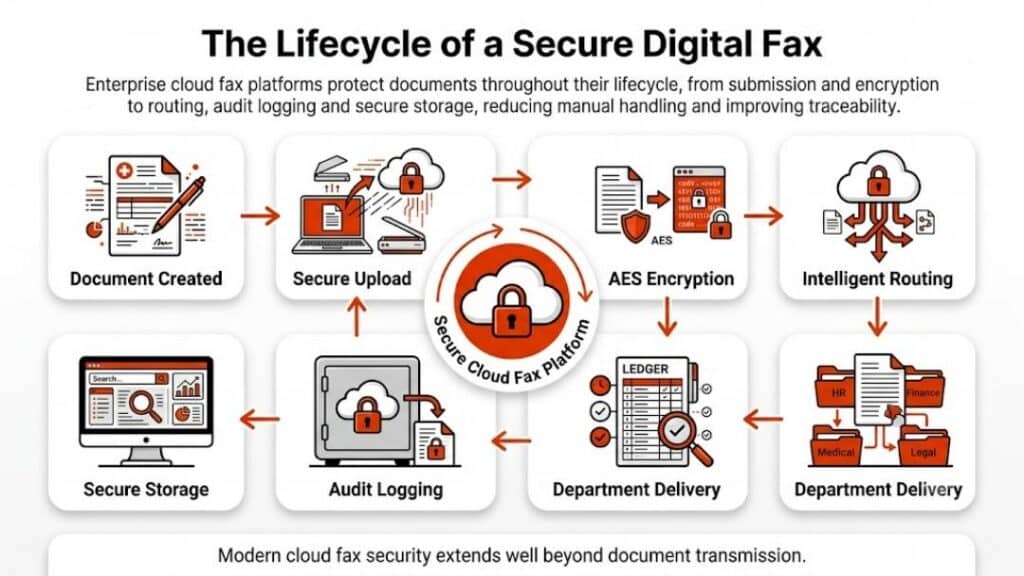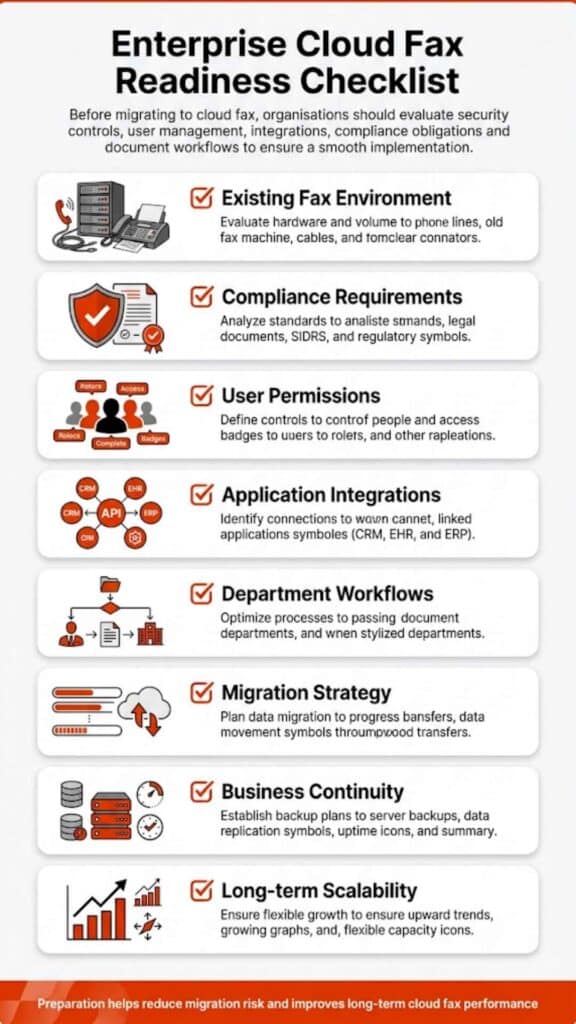
This guide explains how automating incoming fax routing strengthens security, supports regulated environments, and removes repetitive manual tasks that slow down daily operations.
You will see how automated routing moves faxed documents into compliant systems, why routing logic boosts accuracy, how cloud fax workflows help healthcare and enterprise organizations reach consistent performance, and what benefits emerge when manual sorting, paper handling, and unreliable fax machines disappear.
A detailed breakdown of routing components, workflow behavior, and real industry examples helps readers understand how automated routing reshapes document management across clinical, administrative, and operational units.
Automating Incoming Fax Routing as a Foundation for Secure Digital Workflows
Automating incoming fax routing forms the backbone of modern fax communications across healthcare, insurance, financial, and government environments. These sectors rely on a secure fax solution that can send and receive faxes without exposing sensitive information or forcing staff to manage printed documents.
Automated routing directs incoming faxed documents straight into protected workflows, which avoids the risk tied to manual error and reduces the time and resources previously spent on sorting or rescanning pages.
Many organizations run outdated fax machines or legacy fax servers. Those systems create slowdowns, especially during high-volume periods. When teams migrate toward digital routing or replace their on-prem hardware with a more stable option like the Softlinx model described on the fax server, the move produces immediate operational relief.
Routing steps no longer depend on physical devices or analog phone lines, and staff no longer search for missing pages.
What Causes Delays When Incoming Faxes Are Routed Manually?
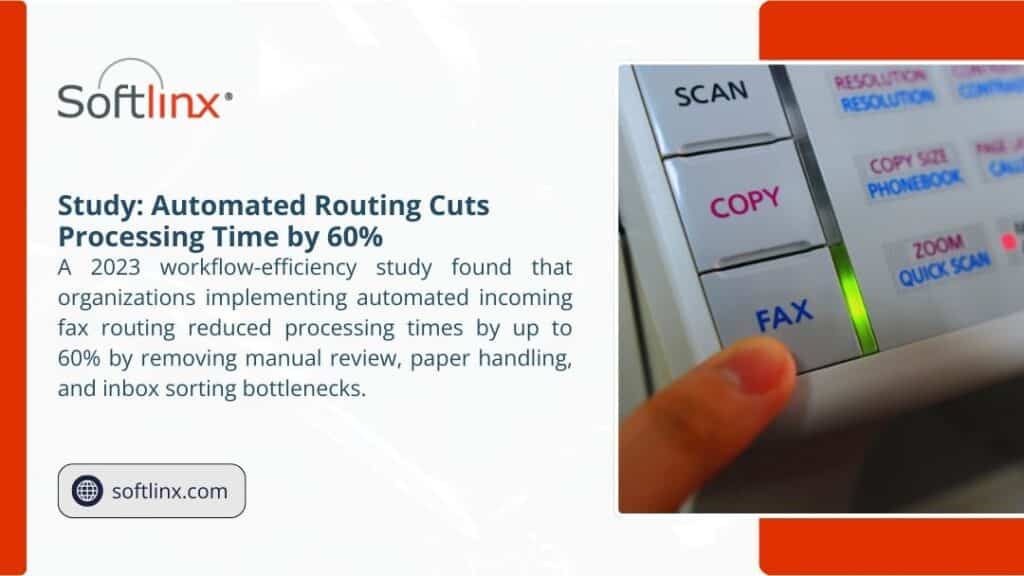
Manual routing slows clinical and administrative teams, especially when fax machines, shared inboxes, or outdated hardware sit at the center of daily workflows. Printed pages pile up, files go to the wrong department, and sensitive documents risk exposure. These delays increase during peak hours or when staff step away from the device, creating gaps that automated routing eliminates immediately.
Why Automating Incoming Fax Routing Matters for Regulated Businesses
Institutions that handle sensitive information must maintain consistent and secure fax communications. Automating incoming fax routing reduces the risk of misplaced or exposed records because the routing engine places each document in a controlled, encrypted environment.
A cloud-delivered route also prevents the common failures that occur with analog lines. Regulated organizations often shift toward transport over a secure internet connection, and many readers gain clarity on this transition through the explanation provided in the guide on faxing through the internet.
The strengthened protection that automated routing provides helps organizations meet strict privacy requirements. Every routed file moves through encrypted storage and verified access pathways, giving compliance officers clear documentation for audits. This also helps maintain consistent retention schedules and supports complete traceability across long-term records.
How Automated Routing Behaves Inside a Cloud Fax Workflow
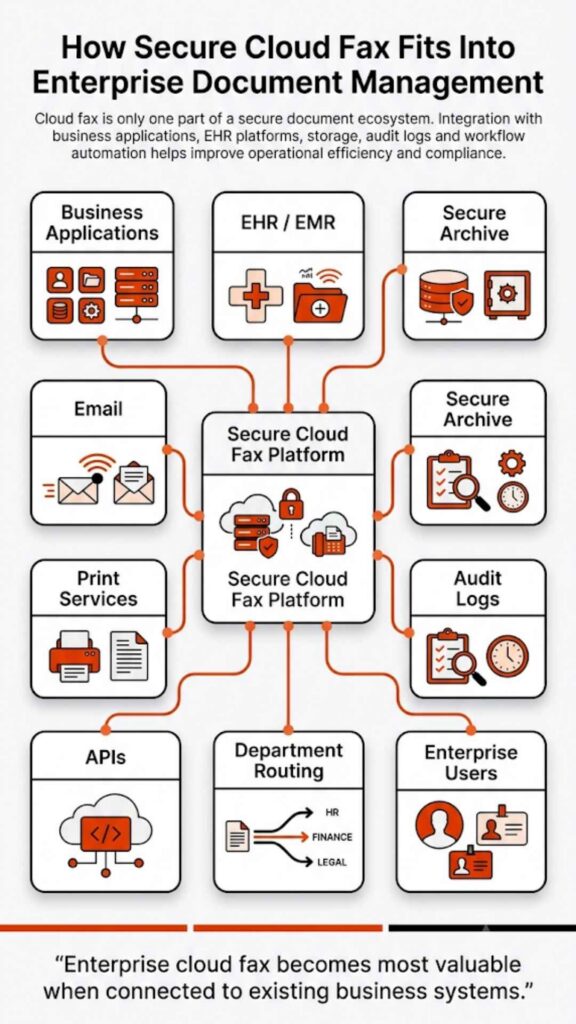
The following table explains the key parts of an automated incoming fax routing system and how they influence daily operations.
Core Components Inside an Automated Incoming Fax Routing Workflow
| Component | Function | Business Impact |
| Routing Engine | Reads sender data, barcodes, and routing rules | Sends incoming faxes to the correct destination without manual effort |
| Secure Storage Layer | Holds documents in encrypted, access-limited repositories | Protects sensitive information from unauthorized access |
| Application Connectors | Moves documents into EHRs, ERPs, or document management platforms | Removes duplicate steps and supports high-volume work environments |
| Notification System | Alerts responsible teams when new documents arrive | Prevents delays and eliminates repeated inbox checks |
| Audit Trail | Logs delivery events, routing decisions, and access activity | Strengthens compliance reporting across regulated industries |
This framework allows automated routing to deliver consistent accuracy every day. For organizations that must send and receive faxes inside an EHR environment, the deeper integration model highlights how routing aligns with clinical workflows.
How Automating Incoming Fax Routing Supports Healthcare Environments
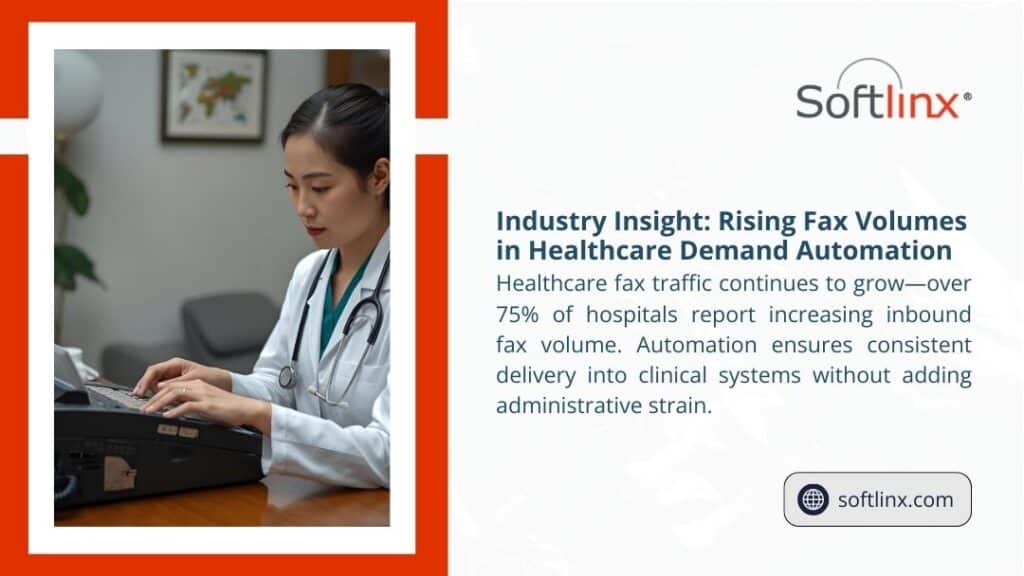
Healthcare organizations face the most intense fax loads. Hundreds or thousands of referrals, lab reports, authorizations, and treatment notes arrive daily. Without automated routing, these documents require manual review and sorting, which slows patient care and increases the risk of misplacement.
Automated routing directs each received fax to the correct clinical or administrative team, and this routing logic aligns naturally with Healthcare Cloud Fax Solutions designed to support secure document delivery, compliance requirements, and high-volume healthcare workflows.
Specialty clinics also benefit greatly. A dermatology practice receives pathology reports and consultation notes throughout the day, and the routing structure outlined in the dermatology clinic cloud fax solutions resource places those documents directly into secure queues without placing extra pressure on front-office staff.
Cardiology groups handle imaging results, EKG interpretations, and discharge updates, and a workflow similar to the one at cardiology practice cloud fax solutions moves those files into the correct review folders as soon as they arrive.
Orthopedic providers manage pre-operative clearances, surgical summaries, and diagnostic reports, and the structured distribution method shown at Orthopedic Clinic Cloud Fax Solutions supports those cases through structured distribution and secure storage.
Chiropractic offices also manage large volumes of incoming faxed documents, such as treatment plans or physician notes. The workflow design available at chiropractic office cloud fax solutions demonstrates how automating incoming fax routing prevents delays and removes unnecessary manual review.
Every healthcare setting, from specialty practices to outpatient centers, must maintain strict safeguards, and the privacy standards explained in Softlinx’s HIPAA-compliant fax requirements reinforce how automated routing protects sensitive information throughout all incoming fax communications.
How Does Automating Incoming Fax Routing Improve Accuracy in Regulated Workflows?
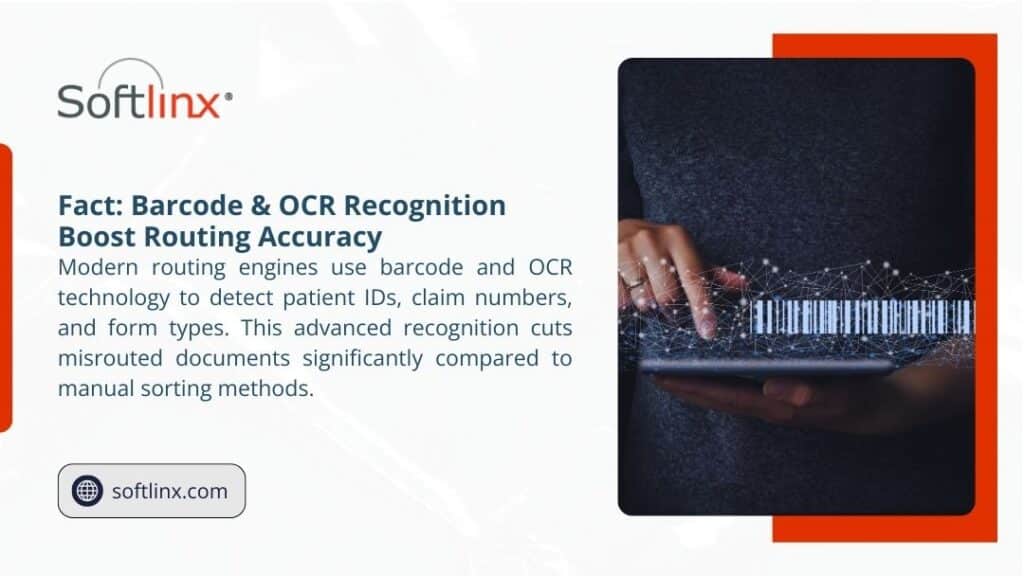
Accuracy increases when routing rules assign each inbound fax to a specific destination without leaving room for human interpretation. Regulated organizations depend on precise document placement, full audit visibility, and controlled file access. Automated routing supports these requirements through rule-based classification, encrypted storage, and defined access pathways that prevent misfiled records or untracked document movement.
How Automating Incoming Fax Routing Improves Document Management?
Automated routing transforms document management by eliminating messy manual sorting. Instead of printing incoming faxes or scanning pages into shared email inboxes, the routing engine directs each record to the correct folder, application module, or workflow queue.
This becomes especially valuable in environments where received faxes influence patient care, supply chain coordination, billing accuracy, or administrative decision-making. Centralized routing also supports distributed teams and remote staff, who gain instant access to incoming files without relying on a physical fax machine. As the volume of fax communications grows, structured routing ensures every received fax moves through a predictable, compliant path.
Organizations that rely on fax heavily often combine automated routing with purpose-specific workflows.
How Automated Routing Removes Problems Created by Legacy Fax Hardware
Legacy fax machines create delays through jams, missing pages, long print queues, and limited storage capacity. On-premise fax servers often require intensive IT support and rely on outdated telephony hardware.
Automating incoming fax routing avoids these issues because routing happens in a secure, digital environment rather than through analog lines. Organizations that want to modernize their transmission path often apply secure VoIP-based faxing.
When routing happens automatically, teams do not wait for printed pages or struggle with unreliable equipment. Instead, documents appear instantly in the systems where staff already work. This helps organizations maintain consistent performance during peak demand periods.
How Automated Incoming Fax Routing Strengthens Security and Compliance
Many incoming documents contain protected health information or other confidential records. Automating incoming fax routing protects these documents by limiting human contact, maintaining encrypted storage, and applying strict access controls.
This approach aligns with HIPAA expectations across administrative, physical, and technical safeguards. For teams reviewing HIPAA questions, the compliance guidance in Softlinx’s overview of HIPAA fax requirements offers additional clarity.
Routing also enhances audit accuracy. Every step is recorded, from transmission to routing to retrieval. Compliance teams can confirm access history, routing behavior, and file locations through the audit trail, simplifying both internal checks and external reviews.
Manual Routing vs. Automated Incoming Fax Routing
| Area | Manual Routing | Automated Routing |
| Delivery Method | Printed pages or email attachments | Encrypted digital delivery into secure workflows |
| Speed | Slower and inconsistent | Immediate routing to assigned teams and systems |
| Data Protection | Higher exposure risk | Controlled access and encrypted storage |
| Labor Impact | Requires constant staff involvement | Removes repetitive administrative steps |
| Reliability | Prone to delays and hardware issues | Rule-driven routing with consistent output |
Organizations exploring cloud-based workflows may also find it valuable to review broader cloud fax capabilities.
How Different Industries Benefit from Automating Incoming Fax Routing
How Different Industries Benefit from Automating Incoming Fax Routing
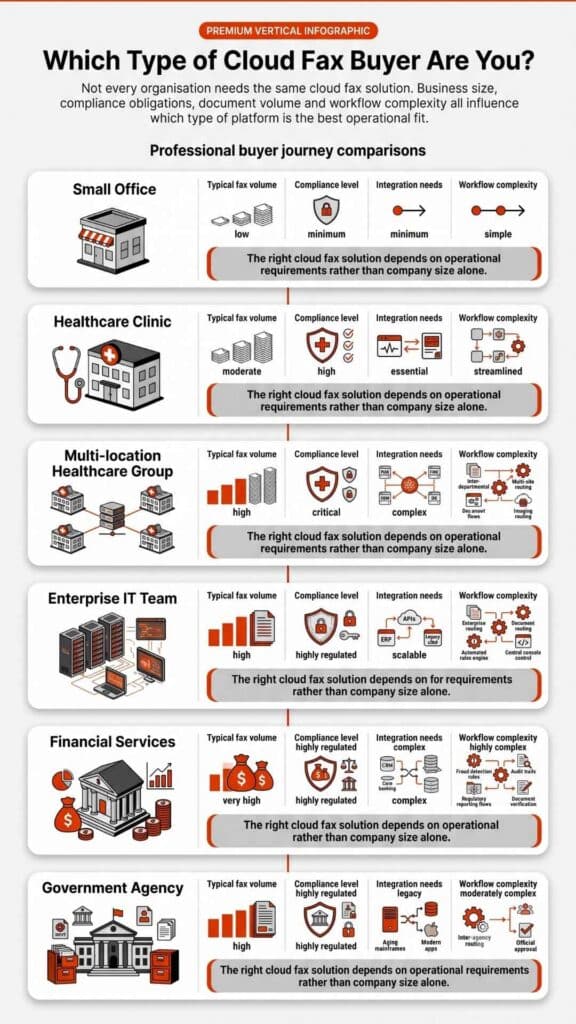
Hospitals route referrals and results into clinical modules. Clinics send and receive faxes without touching a physical machine. Healthcare Fax Solutions support these workflows by helping organizations automate document routing, improve accuracy, and maintain secure, compliant communications across clinical and administrative teams. Insurance carriers sort claims instantly through routing rules. Government agencies handle public requests through consistent document paths. Manufacturing firms process purchase orders and vendor records with less manual review.
Each industry benefits because routing reduces errors, accelerates response times, and ensures sensitive information moves through an encrypted, compliant framework. Organizations that must perform high-volume broadcast or bulk transmissions can extend routing with specialized tools.
Technical Teams: Automating Incoming Fax Routing Through APIs
IT teams can integrate routing directly into internal applications through APIs. This allows each incoming fax to land inside the exact folder, queue, or record field where it must be processed. Projects that require healthcare-specific integration can follow the technical walkthrough.
API-based routing eliminates all manual involvement. Developers apply rules once, and the system handles every future document consistently and securely.
Automating Incoming Fax Routing for Hybrid and Remote Workforces
Remote teams depend on stable access to incoming faxed documents. Automated routing places new documents directly inside secure web portals or connected applications, which makes location irrelevant. Hybrid organizations do not need on-site fax hardware. Instead, incoming records move through consistent routing paths that maintain full compliance visibility.
This also simplifies long-term record management. Audit logs show exactly where each file traveled, who viewed it, and when it entered the system. When retention schedules require precise documentation, automated routing provides the necessary structure.
Routing Rules That Support Accuracy and High-Volume Processing
Routing rules can match incoming fax numbers to departments, specialty units, administrative teams, or file categories. A medical center, for example, can assign one number to its billing department and another to its care coordination team. Routing then delivers each document to the correct location without manual interpretation.
In larger organizations, this reduces the load on administrative teams and strengthens time-sensitive processes. Insurance and financial offices rely heavily on automated classification because each incoming fax begins a new workflow.
Government agencies benefit as well, since they must keep public records organized and accessible. Readers seeking guidance on organizing routing inside complex enterprise workflows can review the Softlinx enterprise fax routing model.
What Automated Routing Solves Across Industries
| Industry | Challenge | Automated Routing Benefit |
| Healthcare | High volume of referrals and reports | Faster routing into clinical systems and secure folders |
| Insurance | Time-sensitive claims and requests | Organized queue assignment and fewer errors |
| Financial Services | Confidential client forms | Encrypted routing with strict access controls |
| Government | Public-facing document flows | Consistent routing for departmental review |
| Manufacturing | Supply chain and vendor records | Reliable delivery into production and logistics workflows |
A Clear Direction for Organizations Ready to Modernize Their Fax Operations
Automating incoming fax routing eliminates delays, prevents manual errors, and helps regulated institutions maintain consistent control over sensitive data. When incoming faxed documents reach the correct team instantly, staff can respond faster, workflows remain stable, and compliance reporting becomes easier to produce.
Automated routing replaces outdated hardware-based handling with a secure digital framework that adapts to the complex operational demands of healthcare, insurance, financial services, government, and manufacturing environments.Organizations evaluating a secure routing model can take the next step by reviewing the available solutions and discussing goals with Softlinx. Start by exploring the Softlinx solutions and consultation.