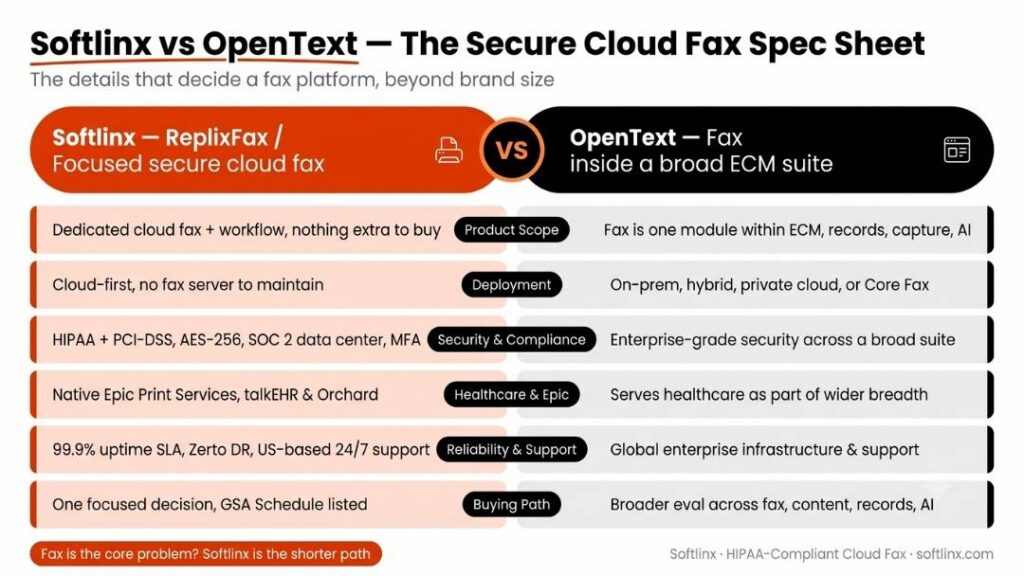
Softlinx vs OpenText is not a simple “which fax tool is better?” debate. It is a choice between a focused secure cloud fax platform built around regulated document delivery and a large enterprise information management vendor with fax, content management, AI, and document systems under one umbrella. For healthcare, finance, insurance, government, and high-volume teams, the better choice depends on how much fax control, workflow depth, deployment flexibility, and vendor ecosystem you need.
In this article, we explore how Softlinx vs OpenText compares for cloud fax, healthcare faxing, enterprise fax server migration, Epic workflows, APIs, OpenText DMS, OpenText Magellan, compliance, pros, cons, and best-fit use cases.
Softlinx vs OpenText
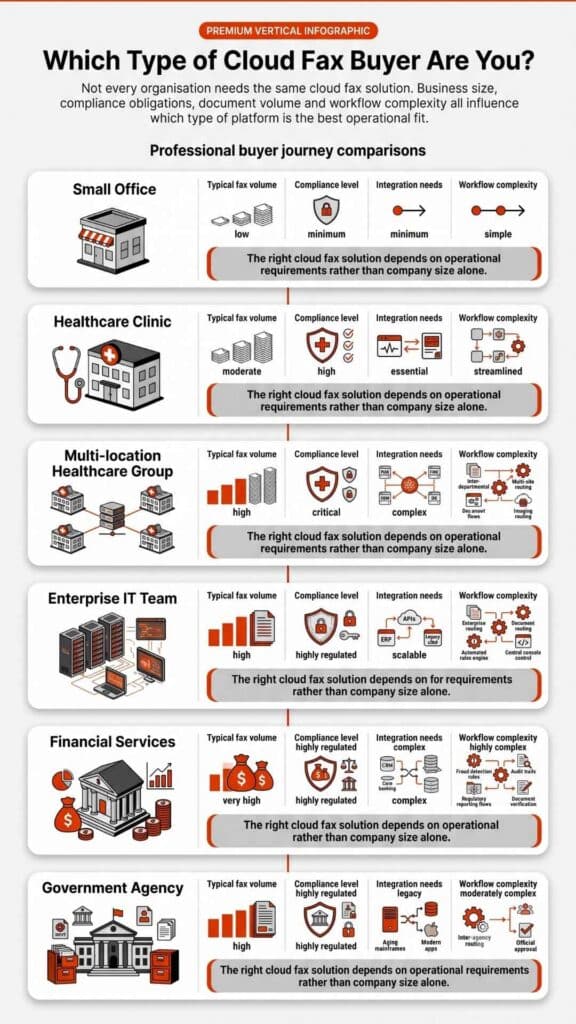
Softlinx vs OpenText matters most when fax is not a side task. In many organizations, fax still carries referrals, claims, lab results, signed forms, loan files, prior authorizations, student health records, and government paperwork. That is why the comparison should not stop at brand size or feature lists. The better question is this: which platform fits the way your team actually sends, receives, routes, audits, and stores sensitive documents?
Softlinx is best understood as a focused cloud fax and secure document delivery provider. Its ReplixFax platform supports secure cloud fax services, HIPAA-compliant healthcare faxing, email-to-fax, web fax, print-to-fax, production fax, APIs, workflow automation, and Epic-related fax workflows. The product is aimed at organizations that still need fax but want less dependence on fax machines, phone lines, local fax servers, and scattered manual handling.
OpenText is a much larger information management company. Its fax portfolio includes OpenText Fax, formerly known as RightFax, and OpenText Core Fax. OpenText Fax supports on-premises, hybrid, and private-cloud deployment, while OpenText Core Fax is positioned as a secure multi-tenant cloud fax platform. It also offers document management, content management, capture, AI, analytics, and automation products beyond fax.
Here’s the thing: OpenText can make sense when fax is one part of a wider enterprise content strategy. Softlinx can make more sense when the main problem is secure, compliant, cloud-based fax delivery for healthcare and regulated business workflows.
| Comparison Point | Softlinx | OpenText |
| Best fit | Healthcare, finance, insurance, government, and enterprise teams that need secure cloud fax without a broad ECM purchase | Large enterprises that want fax as part of a wider OpenText information management ecosystem |
| Core product focus | ReplixFax secure cloud fax, APIs, web portal, workflow, healthcare fax, Epic integration | OpenText Fax, OpenText Core Fax, document management, content cloud, AI and analytics tools |
| Deployment style | Cloud-based fax and document workflow services | On-premises, hybrid, private cloud, and cloud options depending on product |
| Healthcare fit | Strong healthcare and HIPAA fax positioning | Strong enterprise and regulated-industry positioning, with broad product suite |
| API and automation | SOAP and REST fax APIs, workflow automation, delivery manager, barcode fax, production fax | Enterprise integrations, AI fax tools, fax automation, content and process integrations |
| Best buyer | IT, healthcare operations, HIM, revenue cycle, insurance claims, finance operations | Large IT, enterprise architecture, records management, content management, shared services |
For healthcare teams, compliance context matters. The U.S. Department of Health and Human Services makes the baseline clear: “The HIPAA Privacy Rule permits physicians to disclose protected health information to another health care provider for treatment purposes. This can be done by fax or by other means.” That does not mean every fax workflow is safe by default. It means safeguards, access control, audit trails, secure transmission, and careful routing still matter.
Quick Verdict: Secure Cloud Fax or Broad Enterprise Information Management?
Softlinx vs OpenText comes down to scope. Softlinx is the cleaner fit when a team wants a dedicated fax service for healthcare, regulated business document exchange, high-volume faxing, and application-level fax integration. OpenText is the broader choice when the organization already uses OpenText systems or wants fax connected to a wider content, records, AI, or enterprise document strategy.
Softlinx should be on the shortlist when the buyer asks, “How do we replace manual fax work with secure cloud fax, APIs, and workflow controls?” OpenText should be on the shortlist when the buyer asks, “How do we modernize fax inside a much larger enterprise information management stack?”
That difference sounds small, but it is not. A hospital clinic may need Epic cloud fax integration and automated delivery into folders or document workflows. A bank may need controlled fax delivery for loan files and sensitive customer records. An insurer may need cleaner claim document flow. A global enterprise may need a complex enterprise fax server that fits old systems, new systems, private cloud plans, and content governance. The buying path changes with each case.
In plain terms, Softlinx vs OpenText is not a brand popularity contest. It is a workflow fit test.
Choose Softlinx or OpenText Based on This
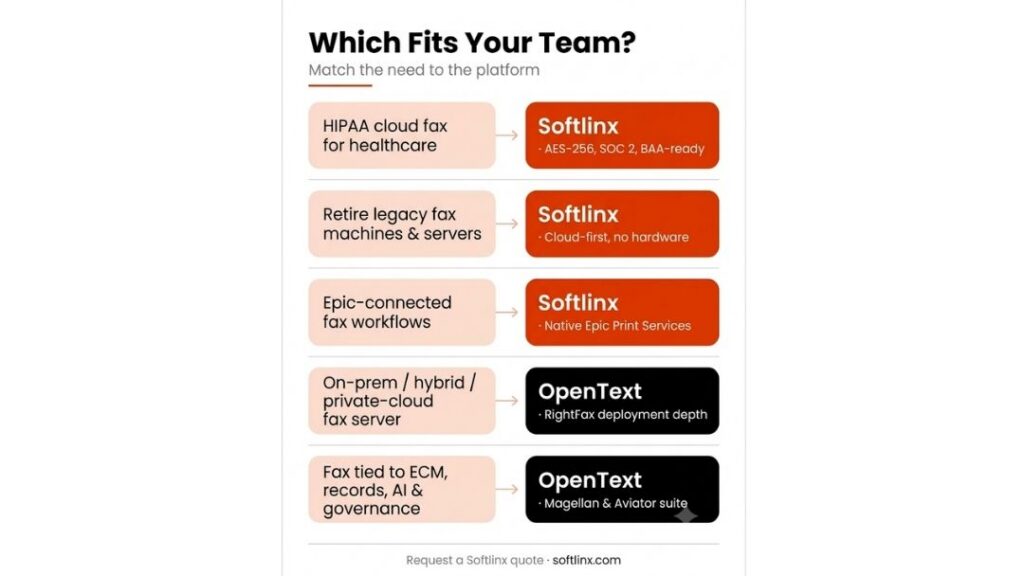
| If your team needs… | Better fit |
| HIPAA-compliant cloud fax for healthcare teams | Softlinx |
| A replacement path for legacy fax machines and fax servers | Softlinx |
| On-premises, hybrid, or private-cloud enterprise fax server deployment | OpenText |
| Fax tied to document management, AI, records, and governance | OpenText |
| Epic-connected cloud fax workflows | Softlinx |
| A broad enterprise information management suite | OpenText |
This is where the buying conversation should start. If your organization mainly needs secure fax delivery, routing, logs, APIs, and healthcare-ready workflows, Softlinx is easier to evaluate. If the project also includes enterprise content management, AI-driven document handling, capture, records, and governance, OpenText may fit the larger plan.
What Softlinx Does Best for HIPAA-Compliant Cloud Fax
Softlinx focuses on the work most teams still wrestle with every day: getting faxes in, getting faxes out, sending them from familiar tools, routing them to the right place, and keeping sensitive information protected. Its strongest positioning is in healthcare, where fax remains tied to referrals, orders, test results, authorizations, and medical records.
The company’s presents ReplixFax as a HIPAA-compliant cloud fax service for healthcare and enterprise businesses. It supports business users, ISVs, developers, IT service providers, and enterprise teams. That range matters because many organizations do not have one single fax use case. They have front desk users, back-office teams, software systems, EHR workflows, and high-volume outbound processes all mixed.
Softlinx also has a practical user-access advantage. Teams can fax through a web fax portal, send documents through email-to-fax, use print-to-fax, or connect business applications through a secure fax API. That mix helps when staff members have different comfort levels and departments do not all work the same way.
For regulated workflows, Softlinx also gives buyers a clear compliance story. Its industry compliance controls cover encryption, secure communication, HIPAA-related safeguards, and BAA-related requirements. For healthcare, that positioning is not window dressing. A fax platform may look simple on the surface, but once patient records, financial files, or legal documents move through it, the system needs strong controls behind the scenes.
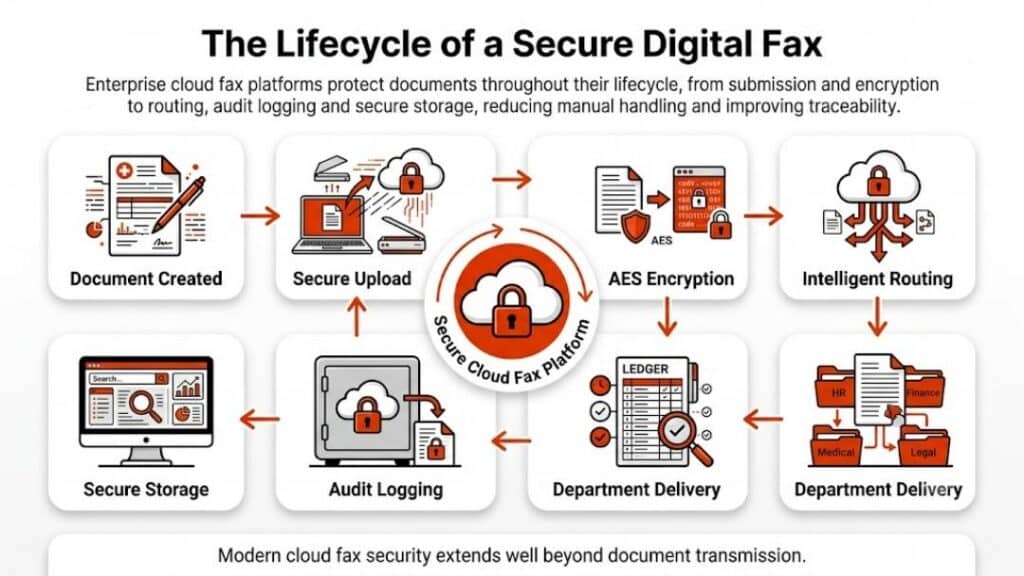
Softlinx also fits high-volume and automated use cases. Its production faxing functionality highlights electronic fax delivery from applications, while its fax workflow automation supports electronic filing, delivery management, inbound and outbound routing, broadcast and mail merge fax, barcode workflows, and automated faxback acknowledgement. For teams stuck with manual review queues, this can help reduce friction without forcing users into a completely new document platform.
Where OpenText Fits: OpenText Fax, OpenText DMS, and OpenText Magellan
OpenText plays a different game. It is not only a fax vendor. It is a global enterprise software provider with information management, document management, cloud content management, AI, cybersecurity, analytics, and workflow tools. That makes the Softlinx vs OpenText decision broader than a fax feature checklist.
OpenText Fax, the product formerly known as RightFax, is a long-standing enterprise fax server solution. OpenText positions it as secure, scalable, and able to integrate with key business systems. It also supports on-premises, hybrid, and private-cloud deployment. That matters for organizations with legacy systems, strict infrastructure rules, or complex internal architecture.
OpenText Core Fax is different. It is OpenText’s secure cloud fax platform. It is meant to replace analog lines, fax hardware, and fax servers while supporting compliant fax across devices and applications. For companies that want OpenText but prefer a cloud-first fax model, Core Fax may be the more relevant product than traditional RightFax.
Then there is OpenText DMS. When people search for OpenText DMS, they are often looking at document management, enterprise content management, records, governance, search, capture, and process integration. That is not the same as buying fax software. A DMS manages content across its lifecycle. A fax platform sends, receives, tracks, and routes fax documents. The two can work together, but they solve different problems.
OpenText Magellan and newer OpenText Aviator tools add another layer. OpenText’s AI direction includes tools for summaries, extraction, routing, and analytics. For a large enterprise that wants AI-assisted handling of unstructured content, OpenText has a broader AI and content stack than Softlinx. But if the actual need is HIPAA-compliant cloud fax with familiar sending options and practical workflow control, that broader stack may be more than the team needs.

Comparison for Enterprise Fax Buyers
Softlinx vs OpenText should be judged by the kind of fax problem your organization has. A simple feature list can mislead buyers because both platforms can support secure fax, application faxing, and regulated workflows. The real difference is depth versus scope.
| Feature Area | Softlinx Advantage | OpenText Advantage |
| Cloud fax simplicity | Strong fit for teams that want focused cloud fax, user tools, APIs, and workflow automation | Strong fit through OpenText Core Fax, especially for buyers already tied to OpenText |
| Enterprise fax server needs | Better when the goal is to move away from local fax infrastructure toward cloud fax | Better when the organization needs on-premises, hybrid, or private-cloud deployment |
| Healthcare workflows | Strong focus on healthcare cloud fax, HIPAA safeguards, EHR workflows, and Epic-related delivery | Strong regulated-industry fit, especially in complex enterprise environments |
| Document management | Focused on fax delivery, routing, logs, and workflow handoff | Stronger for full document management, records, ECM, content governance, and capture |
| AI and analytics | More focused on fax automation than broad AI | Stronger through OpenText Magellan, Aviator, and broader information management tools |
| API use cases | SOAP and REST fax APIs for developers and application fax | Strong enterprise integration ecosystem across fax, content, and business systems |
| Department adoption | Good fit for mixed users who need email, web, print, and application fax | Good fit for large enterprises with established IT governance and OpenText support models |
| Buying complexity | Usually easier to frame as a cloud fax decision | May require broader evaluation across fax, content, records, AI, and infrastructure |
For most buyers, the practical question is not “Which company is bigger?” OpenText is clearly the larger software company. The practical question is, “Which system gives our team the fax workflow we need without unnecessary complexity?” For that reason, Softlinx vs OpenText is closer when the use case is secure cloud fax. OpenText pulls ahead when the buyer wants fax tied to a much wider content and information management program.
Need a focused cloud fax option before renewing or replacing OpenText? Compare your current fax volume, departments, integrations, and compliance needs with Softlinx’s secure cloud fax team before you commit to another enterprise fax server cycle.
Healthcare, Epic, and Compliance Workflows
Healthcare is where Softlinx has its sharpest argument. Its platform is built around healthcare cloud fax, HIPAA-aware document exchange, application faxing, audit trails, secure storage, and EHR-related workflows. For hospitals, clinics, medical centers, labs, pharmacies, and billing organizations, that focus can be valuable because fax is often tied to daily care coordination.
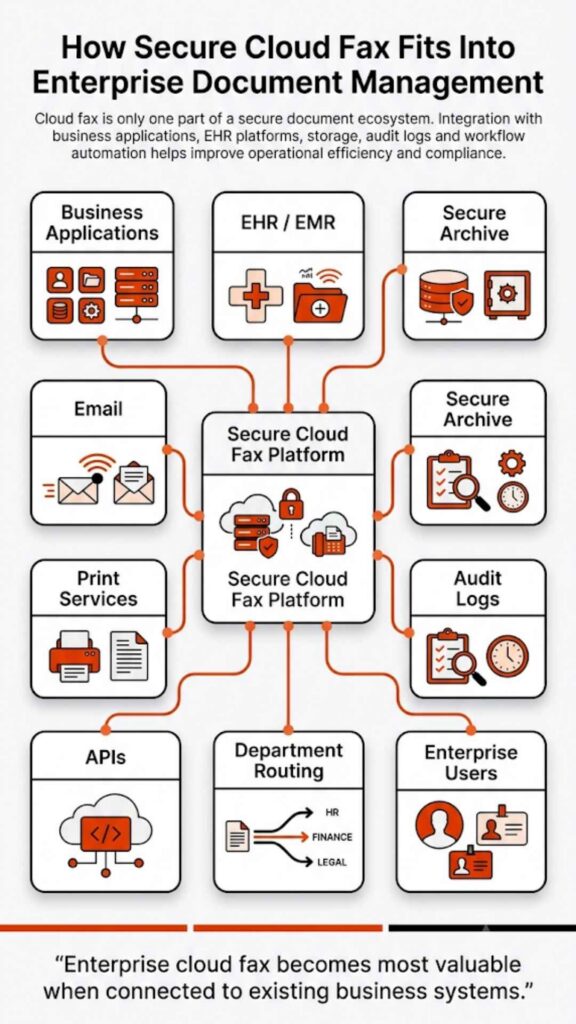
Softlinx’s Epic-related workflow is especially relevant for healthcare IT teams. ReplixFax can receive fax requests through Epic Print Services, send fax status back to Epic, and route inbound faxes through folders, DMS workflows, MFPs, or secure FTP file drops for review and patient-record attachment. This is not just “send a PDF by fax.” It is a workflow bridge between fax traffic and healthcare systems.
OpenText also serves healthcare and other regulated industries, but its stronger story is enterprise breadth. A large health system that already uses OpenText content, capture, or information governance tools may prefer to keep fax inside that broader vendor ecosystem. For another organization, that same breadth may add more evaluation steps than needed.
This is where Softlinx vs OpenText becomes a matter of fit. If the healthcare team wants a focused cloud fax partner for HIPAA-compliant delivery, EHR workflows, and daily fax operations, Softlinx has a direct path. If the healthcare enterprise wants fax, content services, records, AI tools, capture, and governance under a large software suite, OpenText deserves a serious look.
Enterprise Fax Server Migration and IT Control
The phrase enterprise fax server usually points to a very specific pain: old infrastructure that still works but demands maintenance, patches, telecom support, server knowledge, and user support. OpenText RightFax has a long history in that category, and many large companies still associate it with enterprise-grade fax control.
That legacy can be a strength. OpenText Fax supports deployment models that matter to large IT departments, including on-premises, hybrid, and private cloud. If your organization has complex back-end systems, old application dependencies, or policies that do not allow a simple cloud cutover, OpenText may fit the IT roadmap better.
Softlinx approaches the problem from a cloud fax and workflow angle. Its enterprise cloud fax services are built for teams that want secure online faxing, end-user tools, administrative control, APIs, and fewer fax infrastructure headaches. For teams that do not want to keep a fax server alive, that can be the cleaner path.
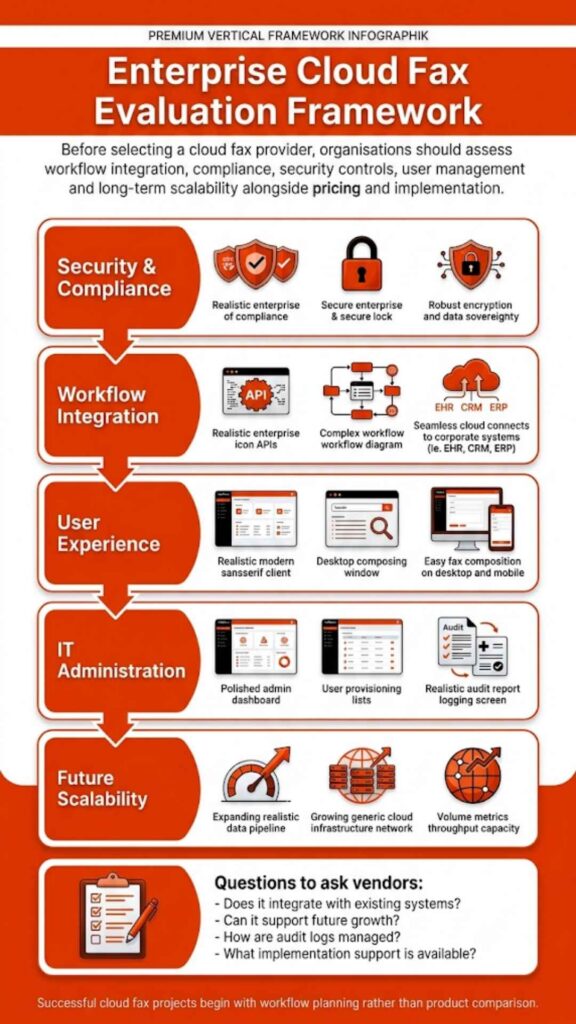
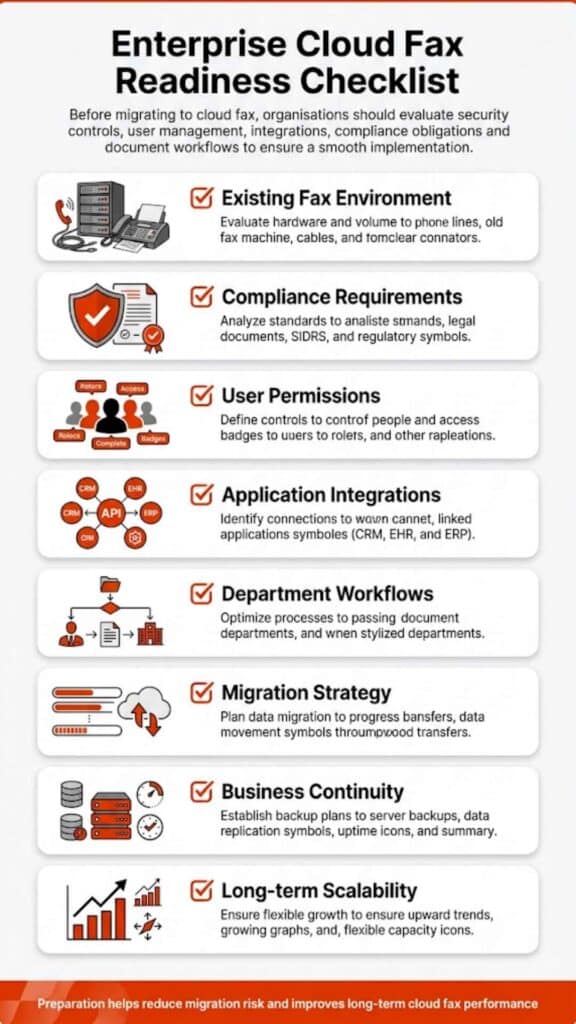
The migration question should be honest. Some organizations are not ready to move every fax workflow to a cloud model. Others are more than ready. Softlinx vs OpenText should be decided after IT maps fax numbers, users, departments, applications, routing rules, retention needs, audit requirements, EHR links, and peak volume periods. Without that map, any comparison turns into guesswork.
Before You Decide: Implementation Checklist
| What to Review | Why It Matters |
| Fax volume by department | High-volume teams may need production fax, routing rules, or API-based sending. |
| Current fax numbers and ownership | A clean migration depends on knowing which numbers belong to which teams, sites, or workflows. |
| EHR, ERP, CRM, or claims-system connections | Application fax needs are different from simple user-to-user fax needs. |
| Inbound routing rules | Healthcare, insurance, finance, and government teams often need faxes routed by department, document type, or workflow. |
| Compliance and audit needs | HIPAA, financial records, claims documents, and public-sector data all require careful access control and traceability. |
| Internal IT preference | Some teams want cloud fax. Others need hybrid, private-cloud, or legacy enterprise fax server support. |
This checklist helps keep the Softlinx vs OpenText decision grounded. It also prevents a common buying mistake: choosing a platform based on brand familiarity before the actual fax workflow has been mapped.
Pros and Cons of OpenText & Softlinx
| Platform | Pros | Cons |
| Softlinx | Strong healthcare and regulated-industry focus. Supports cloud fax, web portal, email-to-fax, print-to-fax, APIs, production fax, workflow automation, and Epic-related fax workflows. Easier to evaluate when the main need is secure fax modernization. Clear fit for teams that do not want a full content management suite. | Not designed to replace a full OpenText DMS. May not be the best fit for enterprises that need broad records management, capture, AI analytics, and content governance from one vendor. Large organizations with deep OpenText contracts may need a more detailed migration review. |
| OpenText | Strong enterprise brand. Offers OpenText Fax, Core Fax, document management, content cloud, OpenText Magellan, and AI-related tools. Flexible deployment options can fit complex IT environments. Strong fit for companies already invested in OpenText. | Can feel too broad for teams that only need secure cloud fax. Evaluation may involve more products, more stakeholders, and a longer buying path. Some buyers may not need the full enterprise information management ecosystem. |
The honest takeaway is that neither platform is “wrong.” Softlinx is more focused. OpenText is broader. That is the heart of the Softlinx vs OpenText decision.
When Softlinx Belongs on Your OpenText Competitors Shortlist
Softlinx belongs on an OpenText competitors shortlist when the buyer is comparing fax solutions, not full enterprise content suites. That distinction matters. If your team searched for OpenText competitors because RightFax feels heavy, on-premises fax has become harder to support, or users want simpler cloud fax access, Softlinx is highly relevant.
Softlinx is also a strong candidate when the organization wants to support several fax methods at once. A front desk user may prefer email-to-fax. A remote worker may prefer web fax. An application may need API fax. A high-volume operation may need production fax. A document team may need barcode fax workflow or automated routing. Softlinx puts those needs under a fax-centered platform rather than a large information management suite.
For finance teams, Softlinx’s financial services faxing can support secure document exchange for sensitive records. For insurers, insurance claims faxing workflows can support claim files, authorizations, and policy documents. For public agencies, government document workflows may be a better fit than a general online fax app.
OpenText remains a strong competitor when the buyer needs more than fax. If the project includes enterprise content management, long-term records, AI-assisted content, discovery, capture, governance, and integration with large business platforms, OpenText may be the more complete enterprise vendor. But for fax-specific modernization, Softlinx gives buyers a more direct route.
Which Platform Should You Choose?
Choose Softlinx if your main goal is secure cloud fax for healthcare, finance, insurance, government, manufacturing, higher education, or enterprise teams that rely on regulated document exchange. It is especially suitable when you need HIPAA-aware workflows, application faxing, email-to-fax, web fax, print-to-fax, API access, Epic-related workflows, production fax, or automated routing without a full ECM project.
Choose OpenText if your organization already runs OpenText, still needs a complex enterprise fax server model, or wants fax tied to broader document management, capture, content governance, OpenText DMS, OpenText Magellan, AI, and enterprise information management. OpenText may also be the safer choice for large IT teams that need flexible deployment models and a broader software ecosystem.
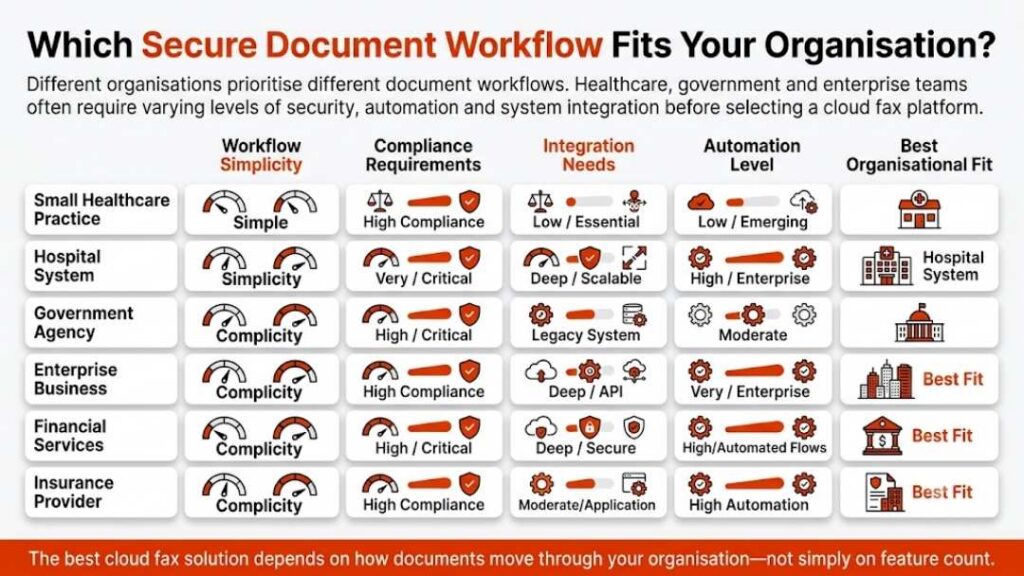
For many mid-to-large organizations, the best path is to define the real problem first. If the problem is fax delivery, routing, auditability, and secure workflow, Softlinx may fit better. If the problem is enterprise information control across many content types and systems, OpenText may fit better. That is why Softlinx vs OpenText should not be framed as small vendor versus large vendor. It should be framed as focused cloud fax versus broad information management.
FAQs About Softlinx vs OpenText
Is Softlinx a good OpenText alternative?
Yes, Softlinx can be a strong OpenText alternative when the main need is secure cloud fax, healthcare faxing, workflow automation, API fax, and regulated document delivery. It is especially relevant for teams that want fax modernization without moving into a broad enterprise content management project.
Is OpenText better than Softlinx?
OpenText may be better for large enterprises that need fax as part of a wider information management stack, including OpenText DMS, capture, records, content governance, and AI tools. Softlinx may be better when the main priority is focused cloud fax for healthcare, finance, insurance, government, or other regulated workflows.
Does Softlinx support Epic fax workflows?
Yes. Softlinx supports Epic-related fax workflows through ReplixFax. Healthcare teams can use Softlinx for Epic-connected fax delivery, fax status workflows, and inbound document routing tied to patient-record processes.
Does OpenText include document management?
Yes. OpenText offers document management and enterprise content management products beyond fax. That is one of the biggest differences in the Softlinx vs OpenText comparison. Softlinx focuses on secure fax and fax workflow, while OpenText offers a broader information management ecosystem.
Which platform is better for healthcare faxing?
Softlinx is often the cleaner fit for focused healthcare cloud fax, HIPAA-aware workflows, Epic-related fax use cases, and day-to-day fax operations. OpenText can fit large healthcare enterprises that also need content management, records, capture, AI, and governance tools across many document types.
The Smarter Next Step
Softlinx vs OpenText is ultimately a workflow decision. OpenText gives enterprises a broad technology stack with fax as one important part of the portfolio. Softlinx gives regulated teams a focused cloud fax platform built around secure delivery, healthcare use cases, APIs, workflow automation, and practical user access.
If your team wants a direct way to modernize fax without a full content management overhaul, Softlinx is worth a closer look. Start with your fax volume, departments, compliance needs, EHR or application connections, and inbound routing rules. Then compare those needs against the platform, not the logo.
For healthcare, finance, insurance, government, and other regulated teams that need secure cloud fax built around real business workflows, request a Softlinx quote and compare it against your current OpenText setup, fax server plan, or cloud fax shortlist.