In healthcare, effective communication is critical to ensuring the delivery of quality patient care. Interhospital communication, which is the exchange of medical information and documents between different healthcare institutions, plays a critical role in treatment coordination, medical record sharing, and overall patient outcomes. However, traditional methods of communication, such as fax machines and paper-based systems, often present significant challenges and inefficiencies. To address these issues, healthcare providers are increasingly turning to cloud faxing solutions. Read on to learn more in this post from Softlinx.
Defining Interhospital Communication
Interhospital communication encompasses the exchange of medical information and documents between hospitals, clinics, and other healthcare facilities. This communication is essential for:
Seamless transitions of care
Coordinating treatment plans
Sharing patient information among healthcare providers
From transferring medical records and lab results to sending prescriptions and consultation notes, effective interhospital communication is vital for delivering comprehensive and coordinated patient care.
Embracing Digital Solutions
According to the Office of the National Coordinator for Health Information Technology (ONC), in 2021, more than 6 in 10 hospitals electronically shared health information and integrated summary of care records into EHRs, a 51% increase since 2017. Despite this progress, traditional methods such as mail or fax still persist in certain aspects of healthcare communication.
However, there’s a notable shift towards digital alternatives. While 69% of hospitals still used traditional mail or fax to send a summary of care records (down from 71% in 2018), 67% also utilized cloud faxing to send these records. This trend underscores the growing recognition of the benefits of digital communication in healthcare.
The Challenges in Interhospital Communication
Hurdles In Traditional Communication Methods
Traditional methods of interhospital communication, such as fax machines and paper-based systems, pose numerous challenges:
Limitations of Traditional Fax Machines: Traditional fax machines are prone to errors and delays, leading to inefficiencies in communication and document exchange.
Risks and Inefficiencies: Handwritten notes and paper-based records can be difficult to decipher, increasing the risk of errors and misinterpretation.
Tracking and Managing Documents: Managing large volumes of paper documents and medical records can be cumbersome and time-consuming, leading to delays and inefficiencies in healthcare workflows.
Regulatory Compliance and Security Concerns
Maintaining patient data security and compliance with healthcare regulations, such as the Health Insurance Portability and Accountability Act (HIPAA), is paramount in interhospital communication. Traditional faxing methods may pose security risks and compliance challenges, putting patient privacy and confidentiality at risk.
The Advantages of Cloud Faxing in Healthcare
Seamless and Secure Document Exchange
Cloud faxing solutions offer a secure and efficient method for transmitting sensitive medical records and documents:
End-to-end Encryption: Cloud-based faxing ensures the secure transmission of sensitive medical records through end-to-end encryption, protecting patient privacy and confidentiality.
Enhanced Accessibility and Mobility
Cloud faxing solutions enable healthcare professionals to access and send faxes from anywhere, at any time:
Flexibility in Communication: Cloud faxing promotes flexibility in interhospital communication, allowing healthcare providers to send and receive faxes conveniently from their smartphones, tablets, or computers.
Mobile Integration: The integration of mobile applications enables healthcare professionals to manage important medical documents while on the go, enhancing mobility and productivity.
Real-time Tracking and Monitoring
Cloud faxing solutions provide real-time visibility into the status of sent and received faxes:
Visibility and Control: Healthcare organizations can track and monitor the status of fax transmissions in real time. This allows them to manage workflows more efficiently and ensure timely delivery of critical documents.
Audit Trail Compliance: Cloud faxing solutions offer comprehensive audit trail functionalities. Healthcare organizations can maintain records of fax transmissions for compliance purposes.
Streamlining Healthcare Workflows
Efficient Handling of Medical Records
Cloud-based fax services streamline the exchange of patient records, prescriptions, and lab results:
Quick Retrieval: Cloud-based fax services enable quick retrieval of patient records and lab results, reducing the time healthcare professionals spend searching for information and allowing for faster and more informed decision-making.
Enhanced Document Organization: Cloud-based fax services offer features for organizing and categorizing medical records, prescriptions, and lab results efficiently. This ensures that healthcare professionals can easily access and manage documents, improving workflow efficiency and reducing administrative burden.
Enhanced Collaboration and Care Coordination
Cloud faxing fosters better communication between hospitals, clinics, and other healthcare providers:
Interoperability: Cloud faxing facilitates interoperability between different healthcare entities, enabling seamless communication and data exchange. This enhanced collaboration leads to faster consultations among healthcare providers, resulting in timely treatment decisions and improved patient care.
Streamlined Referral Processes: Cloud faxing streamlines the referral process by allowing healthcare providers to easily share patient information, referral notes, and relevant medical records with specialists or other healthcare facilities. This promotes efficient care coordination.
Remote Consultations: Cloud faxing enables healthcare professionals to engage in remote consultations and telemedicine appointments by securely exchanging patient information and medical records.
Improved Regulatory Compliance
Cloud faxing solutions ensure adherence to healthcare regulations, reducing the risk of fines and legal issues:
Compliance Assurance: Cloud faxing solutions offer features and functionalities designed to ensure compliance with healthcare regulations, such as HIPAA, reducing the risk of non-compliance and associated penalties.
Secure Data Encryption: Cloud faxing solutions employ robust encryption protocols to safeguard sensitive patient information during transmission, ensuring compliance with data security and privacy regulations. This encryption ensures that patient data remains protected against unauthorized access or interception.
Automated Compliance Reporting: Cloud faxing solutions often include built-in reporting features. These automatically generate compliance reports and audit trails, simplifying the process of demonstrating adherence to regulatory requirements. These reports can be invaluable during audits or regulatory inspections, helping healthcare organizations maintain compliance and avoid potential fines or legal issues.
Choosing the Right Cloud Faxing Partner
Choosing the best online faxing partner is essential for healthcare institutions seeking secure and compliant communication solutions:
Customer-Centric Approach: Look for a provider that demonstrates a commitment to understanding and addressing the specific needs of hospitals and healthcare organizations.
Disaster Recovery Preparedness: Evaluate the disaster recovery capabilities of potential cloud faxing partners. A provider with robust disaster recovery measures in place can help ensure business continuity and data protection.
Comprehensive Support Services: Seek a cloud faxing partner that offers comprehensive support services to assist healthcare institutions in implementing, managing, and optimizing their faxing solutions.
In Summary
In conclusion, cloud faxing solutions offer numerous benefits for improving interhospital communication and enhancing patient care. From secure document exchange to enhanced collaboration and compliance assurance, cloud faxing streamlines healthcare workflows, promotes efficiency and ensures the secure transmission of sensitive medical information.
How to Prevent HIPAA Violations When Faxing Medical Records in 2026
Faxing remains deeply embedded in healthcare communication, even in 2026. The question is no longer whether faxing is allowed under HIPAA, but how to prevent HIPAA violations when faxing patient information. Federal guidance confirms that faxing PHI is permitted; however, violations continue to occur because safeguards break down at the human, technical, and procedural levels. This article explains how to prevent HIPAA violations when faxing by aligning daily fax practices with HIPAA rules, security standards, and modern compliance expectations.
How to Prevent HIPAA Violations When Faxing
Understanding how to prevent HIPAA violations when faxing starts with a simple truth: HIPAA does not prohibit faxing medical records. The HIPAA Privacy Rule allows fax transmission of protected health information for treatment, payment, and healthcare operations, provided reasonable safeguards exist. According to the U.S. Department of Health and Human Services, covered entities must protect PHI from intentional or accidental disclosure when using fax machines or electronic fax systems. That’s where most violations begin.
Many organizations assume fax equals compliance. That assumption causes breaches. HIPAA violations during faxing typically happen because of misdialed numbers, unattended fax machines, shared access, or unsecured storage. Preventing violations requires consistent controls, not outdated habits.
What HIPAA Actually Says About Faxing PHI
Healthcare professionals often ask: Is fax HIPAA compliant, or are faxes HIPAA compliant by default? The answer sits in nuance. HIPAA permits faxing PHI, but only when safeguards are applied. HHS guidance makes it clear that covered entities must use reasonable administrative, technical, and physical protections to limit unnecessary disclosures.
HIPAA fax requirements do not list specific technologies, which means responsibility falls on the organization. Whether a provider uses a traditional fax machine, a fax server, or cloud fax software, compliance depends on execution, not the medium.
The table below summarizes how HIPAA views faxing medical records.
HIPAA Area
What HIPAA Allows
Where Violations Occur
Privacy Rule
Faxing PHI for care and operations
Wrong recipient, no cover sheet
Security Rule
Electronic safeguards for ePHI
Unencrypted digital fax systems
Administrative Safeguards
Policies and workforce training
No documentation or staff oversight
This distinction matters. Faxing PHI is allowed, but unsafe faxing is not.
Common Ways HIPAA Fax Violations Happen
Most HIPAA fax violations occur during routine, everyday tasks rather than extraordinary events, which is exactly why they’re so dangerous.
Violation Scenario
Why It Happens
HIPAA Risk Created
Fax sent to the wrong number
Old contact lists or manual dialing
Unauthorized disclosure of PHI
Unattended fax printouts
Busy staff and shared devices
PHI viewed by unauthorized individuals
Shared fax inboxes
No user-level access controls
No accountability or traceability
Reused fax confirmation sheets
Assumed accuracy without verification
False proof of disclosure
Faxing more data than required
Lack of a minimum necessary review
Excessive exposure of PHI
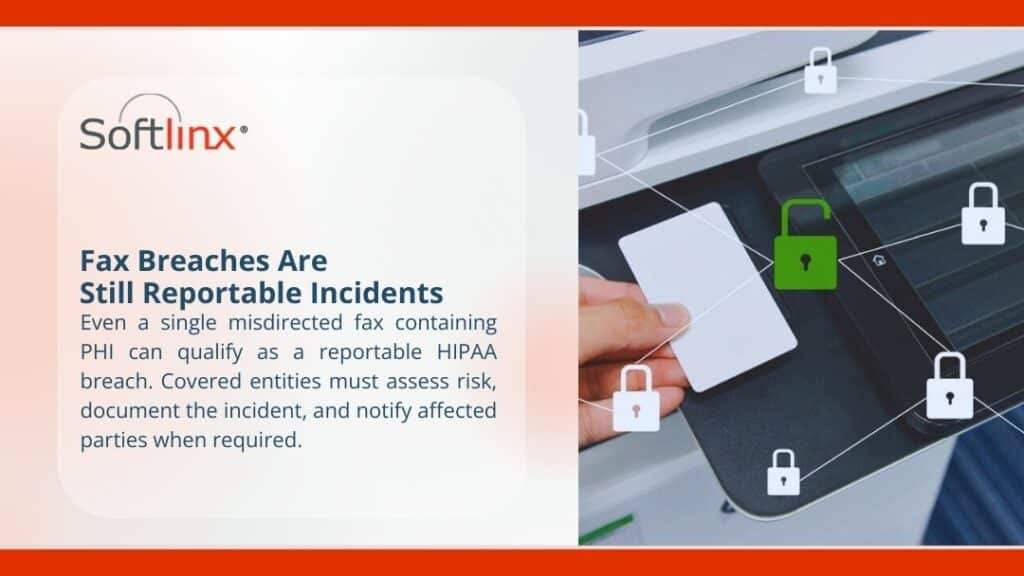
These incidents rarely involve malicious intent, yet they still qualify as reportable breaches under HIPAA.
Administrative Safeguards That Reduce Faxing Risk
Administrative safeguards focus on people, decisions, and accountability rather than technology. Written faxing policies should clearly define who is authorized to send PHI, under which circumstances, and how approval is documented. Without that clarity, compliance becomes guesswork.
Ongoing training plays a larger role than most organizations admit. Staff turnover, role changes, and workflow pressure slowly erode compliance unless refresher education is routine. Administrative safeguards also require assigning ownership, meaning someone is responsible for monitoring fax practices, reviewing incidents, and correcting patterns before they escalate.
Organizations that treat faxing as a regulated disclosure, rather than a background task, tend to experience fewer violations over time.
Technical Safeguards That Support HIPAA Fax Compliance
Technical safeguards determine whether PHI remains protected during transmission and storage, especially as faxing shifts into digital environments.
Technical Control
Function
Compliance Benefit
Encryption in transit
Protects data while sending
Prevents interception
User authentication
Limits system access
Ensures authorized use
Role-based permissions
Restricts PHI visibility
Enforces the minimum necessary
Transmission logs
Records fax activity
Supports audits
Secure digital storage
Prevents local exposure
Reduces paper risk
When these controls work together, faxing PHI becomes traceable, reviewable, and far less prone to silent failure.
Physical Safeguards Still Matter
Physical safeguards are often underestimated because they feel basic, yet they remain a major source of HIPAA violations. Fax machines placed in open areas invite accidental exposure, especially in high-traffic clinical settings.
Controlled placement, restricted access, and timely removal of documents reduce the likelihood that sensitive information sits unattended. Even in digital fax environments, workstations and shared printers must follow access control standards. Physical safeguards serve as the final barrier when administrative rules and technical systems fall short.
Fax Cover Sheets and Verification Protocols
Fax cover sheets and verification steps act as procedural safety nets when human error occurs.
Practice
Purpose
Risk Reduced
Confidentiality disclaimer
Alerts unintended recipients
Limits further disclosure
Sender and recipient details
Identifies responsibility
Improves accountability
Pre-send number verification
Confirms destination
Prevents misdelivery
Approved fax directories
Standardizes contacts
Reduces dialing errors
Error instructions
Guides recipients
Mitigates breach impact
These steps may feel repetitive, but repetition is exactly what prevents one-time mistakes from becoming reportable violations.
Documentation, Audit Trails, and Accountability
HIPAA compliance depends on proof, not assumptions. Audit trails establish who accessed PHI, when it was sent, and whether delivery occurred as intended.
Documentation Element
What It Captures
Why It Matters
Transmission timestamp
Date and time
Establishes timeline
Sender identification
User or department
Assigns responsibility
Recipient confirmation
Delivery status
Confirms disclosure
Access logs
Viewing activity
Detects misuse
Retention records
Storage duration
Supports compliance reviews
Without documentation, even well-intentioned fax practices become difficult to defend during audits or investigations.
Comparing Traditional Faxing and Secure Digital Faxing
The table below illustrates how different fax approaches affect HIPAA compliance risk.
Fax Method
Compliance Strength
Primary Risk
Analog fax machine
Allowed under HIPAA
Physical exposure
Network fax server
Controlled access
Internal misuse
Cloud-based faxing
Encrypted, auditable
Vendor oversight
Organizations sending high volumes of PHI often move away from standalone fax machines toward cloud-based systems because oversight becomes manageable.
Healthcare providers exploring fax through the internet models often cite better control, fewer errors, and clearer accountability.
Industry-Specific Faxing Considerations
HIPAA fax compliance looks different depending on the care setting. Hospitals manage high-volume intake across departments, which increases exposure if routing fails. Secure hospital cloud fax solutions reduce that complexity by centralizing control.
Clinics face different challenges, such as staff multitasking and limited IT oversight. Clinic cloud fax solutions help standardize faxing without adding workflow friction.
Specialty providers, from urgent care to rehabilitation centers, rely on faxing during referrals and transitions of care. Tailored systems, such as outpatient clinic cloud fax solutions, reduce handoffs that cause mistakes.
Why HIPAA Fax Compliance Still Breaks Down
Compliance breakdowns rarely stem from ignorance of the rules. They come from fatigue, pressure, and normalization of risk. Staff begin to trust systems without verification, reuse old habits, and assume nothing will go wrong this time.
Over time, minor deviations stack up. A skipped confirmation here, an unattended document there, until one incident triggers a breach notification. HIPAA compliance erodes gradually, not suddenly, which makes proactive oversight essential.
Where Secure Faxing Is Headed in 2026
Faxing remains relevant because healthcare ecosystems move slowly. However, compliance expectations continue to rise. Regulators expect better documentation, faster breach response, and fewer excuses.
Organizations that rely on HIPAA-compliant fax services with built-in auditability place themselves in a stronger position when scrutiny arrives. Modern compliance depends less on intent and more on evidence.
Why This Matters More Than Ever
HIPAA enforcement has become more sophisticated, and tolerance for preventable disclosures has shrunk. Patients expect privacy, regulators expect evidence, and organizations bear the consequences when either is missing.
Preventing HIPAA violations when faxing protects more than compliance status. It protects trust, reputation, and operational continuity. Healthcare organizations that want reliable, compliant faxing at scale increasingly turn to experienced providers who understand both regulation and reality.
If your organization is reassessing how it handles faxed PHI, Softlinx offers secure, healthcare-focused fax solutions designed to support compliance without disrupting care delivery. Now is the moment to replace risk with control and uncertainty with accountability.
January 26, 2026
How to Reduce Fax Errors in 2026 Without Breaking Your Workflow
Fax errors haven’t disappeared. They’ve just changed form. Between unstable phone lines, VoIP conflicts, and human mistakes, businesses still lose time to failed transmissions. This guide explains how to reduce fax errors in practical, repeatable ways that hold up in real operations, especially in healthcare and regulated environments.
How to Reduce Fax Errors Starts With Understanding What Actually Goes Wrong
Most people treat fax errors like random glitches. They’re not. Almost every fax error traces back to a small group of causes: line instability, incompatible systems, incorrect fax numbers, or poorly designed workflows. When people search for how to reduce fax errors, they’re usually reacting to messages like fax failed, no answer, or communication error, not looking for theory.
Fax transmission still relies on precise timing between the sending and receiving endpoints. If the phone line drops for even a moment, or the receiving fax machine doesn’t respond fast enough, the fax did not go through. Add VoIP compression, shared office lines, or outdated machines, and the failure rate climbs fast. Reducing fax errors means addressing the system, not just retrying the send.
Why fax transmissions fail more often than people expect
But here’s the problem. Fax technology was designed for analog phone lines, not digital networks. Many offices now send faxes over VoIP or shared data connections, which introduces jitter, packet loss, and timing mismatches. That’s when users start asking why their fax is not going through or why their fax won’t go through even though the number looks correct.
Another common issue sits on the receiving end. A fax machine not working properly may still pick up voice calls but fail to negotiate a fax handshake. That results in errors like fax says no answer or fax machine no answer, even when someone is physically near the device.
Human error adds fuel to the fire. A single-digit mistake in a fax number, missing an area code or country code, or sending to a line that no longer accepts faxes leads to fax transmission error messages that look technical but are actually procedural.
What common fax error messages really mean
Most people see error messages and assume the machine is broken. Often, it isn’t. The table below breaks down what these messages usually mean and how to reduce fax errors tied to each one.
Fax error message
What it usually means
Why does it keep happening
No answer fax meaning
The receiving fax did not pick up
Auto-answer disabled or line busy
Fax failed, no answer
Call connected, but no fax tone
Voice line or incompatible device
Fax communication error
Data loss during transmission
Poor line quality or VoIP compression
Fax sent, no answer
Handshake never completed
Timing mismatch or outdated machine
Line under communication fax meaning
Line already in use
Shared phone line or call waiting
When users repeatedly see messages like fax results with no answer or fax failed, the instinct is to resend. That might work once. It does nothing to reduce fax errors long term.
Practical fixes that reduce fax errors without new equipment
So here’s what happened when organizations actually reduced error rates without replacing everything.
First, they stopped sharing fax lines. A fax line not working often turns out to be a line overloaded with voice traffic. Second, they verified destination numbers every time. Double-check the fax number, including area code, extension rules, and whether the destination still accepts faxes.
Third, they adjusted the send settings. Lowering transmission speed can help older fax machines receive pages more reliably. This alone resolves many fax machine not sending or receiving complaints.
Fourth, they broke large documents into smaller batches. Long transmissions increase the chance of interruption. Shorter sends succeed more often and reduce fax errors across the board.
These steps help, but they cap out quickly. That’s why organizations eventually hit a ceiling with traditional machines.
Where traditional fax machines hit their limits
Traditional fax machines fail for reasons no checklist can fully fix. Hardware ages. Rollers wear down. Memory fills up. Firmware stays outdated. When a broken fax machine shows intermittent errors, troubleshooting turns into guesswork.
Fax machines also depend on physical phone lines. Any noise on the line, even electrical interference, can cause failure to send or receive a fax. That’s why businesses stuck with analog systems keep searching for how to fix a fax machine or how to fix fax machines with no answer, over and over. This is where system-level changes start to matter.
How modern fax infrastructure reduces errors by design
Organizations that significantly reduce fax errors stop relying on standalone devices. They centralize faxing.
A centralized fax server replaces individual machines with controlled routing, retries, and detailed error logs. Instead of guessing why a fax failed, IT teams see the exact error code and response from the destination system. That alone shortens resolution time and prevents repeat failures.
Moving one step further, cloud fax removes phone lines altogether. Fax transmission happens over secure data channels with built-in error correction. Because cloud platforms manage connectivity centrally, issues like a fax line not working or a fax machine not answering disappear.
For offices using VoIP, a VoIP fax configured properly avoids compression issues that break traditional fax tones. When done incorrectly, VoIP causes constant fax communication error messages. When done right, it stabilizes sending and receiving across locations.
Reducing human error through better workflows
Technology helps, but people still matter. Many fax errors come from rushed processes. Staff enter fax numbers manually, skip confirmations, or misread error messages.
Automation changes that. When organizations adopt methods like sending documents via email-based workflows, the chance of mistyped numbers drops sharply. The same principle applies to communication workflows, where how to email to a fax number shows how controlled inputs help reduce transmission errors and manual rework.
Automated routing also prevents faxes from landing in the wrong inbox or queue. Instead of someone manually forwarding documents, systems handle it consistently. This approach cuts down on lost pages and repeated sends.
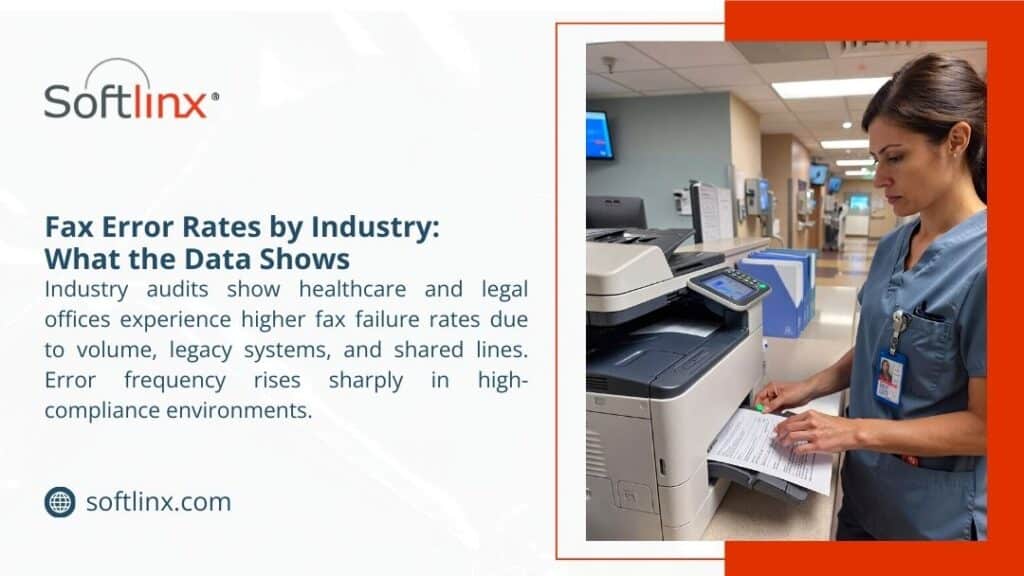
Fax errors in healthcare carry a higher risk
In healthcare, fax errors don’t just waste time. They increase compliance risk. A misdialed fax number can expose protected health information, triggering HIPAA violations.
The U.S. Department of Health and Human Services has identified misdirected faxes among the types of impermissible disclosures that can trigger reportable HIPAA data breaches.
Using HIPAA fax systems with audit trails and access controls helps prevent these incidents. Secure healthcare fax practices are detailed here: https://softlinx.com/hipaa-fax/
Many organizations still ask whether faxing HIPAA is fax HIPAA compliant. The short answer is yes, but only when controls exist. This breakdown clarifies when faxing meets HIPAA standards and when it does not.
Connecting the fax to clinical systems reduces repeat failures
Another overlooked source of fax errors is manual data handling between systems. When staff print, scan, and resend documents, mistakes multiply. Direct EHR integration removes those steps. When faxes flow straight into patient records, there’s less resending, fewer wrong numbers, and clearer confirmation. Healthcare organizations that move to secure fax through the internet also report fewer transmission failures because they no longer rely on unstable phone infrastructure.
Comparing error risk across fax approaches
The table below shows how different fax setups affect reliability.
Fax approach
Typical error rate
Primary risk factor
Standalone fax machine
High
Line noise and hardware failure
Shared office fax line
Medium to high
Busy signals and call conflicts
Fax server
Low
Configuration errors
Cloud fax
Very low
Internet outage only
This is why organizations focused on how to reduce fax errors eventually shift away from physical machines.
What reducing fax errors looks like long-term
Reducing fax errors isn’t about eliminating fax overnight. It’s about making failures predictable, traceable, and rare. Organizations that succeed stop asking why does my fax keeps failing and start monitoring transmission data. They look at patterns, not individual mishaps. They move away from guessing how to fix a fax machine and toward systems that surface the real issue immediately. For high-volume environments, enterprise solutions that guarantee uptime and retries matter.
Turning fax from a liability into a controlled process
Fax will stick around longer than anyone expects, especially in healthcare, government, and finance. The difference between constant frustration and smooth operations comes down to design choices.
When you understand why fax errors happen, address weak points in connectivity, remove manual steps, and adopt modern infrastructure, failure stops being the norm. That’s how to reduce fax errors in a way that holds up tomorrow, not just on the next resend.
If repeated failures slow your operations today, moving toward centralized or cloud-based fax systems may be the cleanest way to restore reliability and confidence without disrupting existing workflows.
January 22, 2026
Hidden Costs of Traditional Fax: Most Businesses Still Overlook
The hidden costs of traditional fax rarely show up on invoices. Hardware looks cheap. Fax services appear simple. But once phone lines, labor time, compliance exposure, and workflow friction enter the picture, fax cost balloons quietly.
This article breaks down what businesses actually pay to send and receive faxes, and why those costs persist long after the machine is installed.
Hidden Costs of Traditional Fax: What the Invoice Never Shows
The hidden costs of traditional fax begin the moment a business commits to a dedicated fax machine. At first glance, faxing seems inexpensive. A device sits in the corner. A fax number exists. Documents move. But here’s the problem. Traditional faxing spreads its costs across hardware, infrastructure, labor, and risk. None of it looks dramatic on its own. Together, it adds up quickly.
Fax machines require more than electricity and paper. They rely on an analog infrastructure that modern offices no longer use for anything else. A dedicated phone line exists solely for fax transmission, often costing between $25 and $50 per month, depending on the carrier.
The analog business line pricing has steadily increased as telecom providers shift away from copper networks, making fax line costs a long-term liability rather than a fixed expense. That line does nothing when documents aren’t moving. Yet the bill arrives every month.
The Real Cost of Fax Machines and Hardware Ownership
A fax machine cost looks manageable at checkout. Entry-level units sell for a few hundred dollars. Enterprise models climb much higher. But the purchase price tells only part of the story. Traditional fax machines age fast. Mechanical parts fail. Rollers wear out. Toner dries up. Replacement parts grow scarce. According to Total Cost of Ownership research and IDC’s analysis of IT hardware maintenance costs, the full lifecycle expenses of office hardware, including repairs, service, downtime, and support, often rival or exceed the original purchase price over a typical 5-year period. This creates a rolling cost cycle that never truly ends.
Equipment Costs That Never Really End
A traditional fax machine rarely stays a one-time purchase. Most businesses underestimate how much a fax machine costs once the full lifecycle comes into view. Hardware prices vary, but maintenance never truly stops. Replacement parts, routine service calls, toner, and paper quietly increase the fax machine cost year after year.
Energy use adds another layer. According to the report, office equipment left powered on outside business hours continues to draw electricity, creating unnecessary power consumption that often goes unnoticed. Older fax machines, in particular, lack modern energy controls, which makes idle usage yet another hidden drain tied to outdated systems.
Fax Equipment Expense
Typical Ongoing Impact
Dedicated fax machine
Maintenance and repair cycles
Toner and paper
Continuous replenishment
Power usage
Idle energy draw
Once these recurring expenses surface in annual reviews, many organizations begin to understand why faxing is so expensive, even when fax volume remains steady.
Dedicated Fax Lines: The Cost That Never Stops
Fax line cost remains one of the most persistent hidden expenses. Unlike internet-based systems, traditional faxing depends on analog connectivity. That means a business pays for a line even if fax volume drops.
Many organizations still ask, How much does a fax line cost? The answer varies, but averages remain stubbornly high. According to pricing data, business analog lines routinely exceed $30 per month before taxes and fees. Over five years, that single fax line quietly exceeds the cost of the fax machine itself.
Paper, Toner, and Storage: The Fax Cost Nobody Tracks
Faxing consumes paper whether recipients want it or not. Toner cartridges for fax machines often cost more per page than modern printers due to lower production volumes. Paper storage becomes another silent drain. Physical filing cabinets occupy office space that carries real rent costs.
A study by Gartner found that organizations spend between 1% and 3% of total annual revenueson document output (including copiers, printers, fax machines, and scanners). Faxing contributes directly to that figure. Those costs rarely appear under fax services in accounting software. They hide inside operational overhead.
Labor Time and Workflow Disruption
Traditional faxing interrupts people. Someone prints a document. Someone walks to the machine. Someone waits. Someone resends when the line fails. Someone files paper afterward. None of that work creates value.
According to the Bureau of Labor Statistics, employer labor compensation costs, including wages and benefits, account for a significant portion of total workplace spending, averaging around $48.05 per hour worked for civilian workers in 2025, with wages alone making up about 702% of that cost.
This highlights how labor expenses, especially in administrative and office support roles, can quickly outweigh equipment or hardware costs in document-heavy environments. This is where the hidden costs of traditional fax become impossible to ignore.
Compliance Exposure and Error-Driven Costs
Fax machines do not verify recipients. Misdialed numbers remain a leading cause of document exposure. In healthcare, this matters. Paper left on fax trays exposes sensitive information. Staff re-fax documents multiple times without tracking delivery confirmation. Each error creates risk. Risk carries cost.
Organizations exploring whether fax is HIPAA compliant often discover that compliance depends entirely on process controls, not on the machine itself. Understanding HIPAA fax requirements matters more than most businesses realize, especially when sensitive information moves daily.
Comparing Traditional Fax Cost vs Digital Alternatives
The table below shows how traditional fax expenses stack up against modern approaches over time.
Cost Category
Traditional Fax
Digital Fax
Fax machine cost
High upfront
None
Fax line cost
Monthly recurring
Included
Paper and toner
Continuous
None
Maintenance
Ongoing
Minimal
Compliance risk
High
Reduced
Scalability
Limited
Flexible
Digital fax solutions remove hardware dependency entirely. They rely on centralized fax server infrastructure rather than individual machines, which reduces failure points and administrative burden. Businesses that evaluate a fax server approach often find that cost predictability improves almost immediately.
Retail Fax Services: Why Pay-Per-Page Adds Up
Many people ask, How much does it cost to fax at Staples? or How much does UPS charge to send a fax? Retail fax services look convenient but charge per page, often between $1.50 and $3.00 for local transmissions. UPS fax cost per page increases for long-distance or international destinations.
Over time, these ad-hoc charges rival the cost of owning a dedicated fax machine, without offering security, audit trails, or reliability. Staples fax cost and UPS fax service pricing appeal for emergencies, not for ongoing business operations.
Retail Fax Provider
Typical Cost Structure
Staples fax service
Per-page pricing, domestic and international
UPS fax service
Per page plus service fees
Local fax store near me
Variable pricing
What starts as a quick errand often turns into a recurring operational expense, particularly for businesses that send forms, contracts, or multi-page documents on a regular basis.
Total Cost of Ownership: The Metric That Matters
Total cost of ownership captures what traditional fax hides. Hardware, phone lines, labor time, consumables, compliance exposure, and opportunity loss belong in the same calculation.
Cost Type
Visible
Hidden
Hardware
Yes
No
Phone line
Yes
Sometimes
Paper and toner
Sometimes
Yes
Labor time
No
Yes
Compliance exposure
No
Yes
When organizations evaluate fax cost honestly, the math changes.
Why Businesses Move Away from Traditional Fax
Traditional faxing persists because it feels familiar. But familiarity does not equal efficiency. Cloud-based fax delivery allows organizations to send and receive faxes through the internet, removing analog dependencies entirely. Businesses that explore cloud fax infrastructure often discover fewer errors, clearer audit trails, and reduced administrative load.
Healthcare organizations frequently integrate fax directly into EHR systems to eliminate manual routing and scanning. Learning how to connect fax to EHR platforms reduces handling errors while supporting regulatory compliance.
Conclusion
The hidden costs of traditional fax rarely appear in procurement discussions. They surface later, inside support tickets, billing statements, and compliance reviews. Organizations that calculate fax cost beyond hardware begin to question why outdated systems remain in place.
This might work for you if your business sends only a handful of faxes per year. But for regulated industries, high-volume environments, or teams handling sensitive information, traditional fax becomes one of the most expensive legacy habits still in use.
Understanding the full cost picture helps leaders decide whether maintaining analog fax infrastructure still makes sense or whether modern fax solutions align better with operational reality.
If reducing recurring overhead, improving document security, and regaining staff time matter, examining alternatives becomes less about technology and more about accountability. Traditional faxing doesn’t just slow work down; it locks organizations into ongoing risk and inefficiency. Softlinx provides secure, enterprise-grade cloud fax built for regulated environments that still rely on fax to move critical information.
Hidden Costs of Traditional Fax: Most Businesses Still Overlook
The hidden costs of traditional fax rarely show up on invoices. Hardware looks cheap. Fax services appear simple. But once phone lines, labor time, compliance exposure, and workflow friction enter the picture, fax cost balloons quietly.
This article breaks down what businesses actually pay to send and receive faxes, and why those costs persist long after the machine is installed.
Hidden Costs of Traditional Fax: What the Invoice Never Shows
The hidden costs of traditional fax begin the moment a business commits to a dedicated fax machine. At first glance, faxing seems inexpensive. A device sits in the corner. A fax number exists. Documents move. But here’s the problem. Traditional faxing spreads its costs across hardware, infrastructure, labor, and risk. None of it looks dramatic on its own. Together, it adds up quickly.
Fax machines require more than electricity and paper. They rely on an analog infrastructure that modern offices no longer use for anything else. A dedicated phone line exists solely for fax transmission, often costing between $25 and $50 per month, depending on the carrier.
The analog business line pricing has steadily increased as telecom providers shift away from copper networks, making fax line costs a long-term liability rather than a fixed expense. That line does nothing when documents aren’t moving. Yet the bill arrives every month.
The Real Cost of Fax Machines and Hardware Ownership
A fax machine cost looks manageable at checkout. Entry-level units sell for a few hundred dollars. Enterprise models climb much higher. But the purchase price tells only part of the story. Traditional fax machines age fast. Mechanical parts fail. Rollers wear out. Toner dries up. Replacement parts grow scarce. According to Total Cost of Ownership research and IDC’s analysis of IT hardware maintenance costs, the full lifecycle expenses of office hardware, including repairs, service, downtime, and support, often rival or exceed the original purchase price over a typical 5-year period. This creates a rolling cost cycle that never truly ends.
Equipment Costs That Never Really End
A traditional fax machine rarely stays a one-time purchase. Most businesses underestimate how much a fax machine costs once the full lifecycle comes into view. Hardware prices vary, but maintenance never truly stops. Replacement parts, routine service calls, toner, and paper quietly increase the fax machine cost year after year.
Energy use adds another layer. According to the report, office equipment left powered on outside business hours continues to draw electricity, creating unnecessary power consumption that often goes unnoticed. Older fax machines, in particular, lack modern energy controls, which makes idle usage yet another hidden drain tied to outdated systems.
Fax Equipment Expense
Typical Ongoing Impact
Dedicated fax machine
Maintenance and repair cycles
Toner and paper
Continuous replenishment
Power usage
Idle energy draw
Once these recurring expenses surface in annual reviews, many organizations begin to understand why faxing is so expensive, even when fax volume remains steady.
Dedicated Fax Lines: The Cost That Never Stops
Fax line cost remains one of the most persistent hidden expenses. Unlike internet-based systems, traditional faxing depends on analog connectivity. That means a business pays for a line even if fax volume drops.
Many organizations still ask, How much does a fax line cost? The answer varies, but averages remain stubbornly high. According to pricing data, business analog lines routinely exceed $30 per month before taxes and fees. Over five years, that single fax line quietly exceeds the cost of the fax machine itself.
Paper, Toner, and Storage: The Fax Cost Nobody Tracks
Faxing consumes paper whether recipients want it or not. Toner cartridges for fax machines often cost more per page than modern printers due to lower production volumes. Paper storage becomes another silent drain. Physical filing cabinets occupy office space that carries real rent costs.
A study by Gartner found that organizations spend between 1% and 3% of total annual revenueson document output (including copiers, printers, fax machines, and scanners). Faxing contributes directly to that figure. Those costs rarely appear under fax services in accounting software. They hide inside operational overhead.
Labor Time and Workflow Disruption
Traditional faxing interrupts people. Someone prints a document. Someone walks to the machine. Someone waits. Someone resends when the line fails. Someone files paper afterward. None of that work creates value.
According to the Bureau of Labor Statistics, employer labor compensation costs, including wages and benefits, account for a significant portion of total workplace spending, averaging around $48.05 per hour worked for civilian workers in 2025, with wages alone making up about 702% of that cost.
This highlights how labor expenses, especially in administrative and office support roles, can quickly outweigh equipment or hardware costs in document-heavy environments. This is where the hidden costs of traditional fax become impossible to ignore.
Compliance Exposure and Error-Driven Costs
Fax machines do not verify recipients. Misdialed numbers remain a leading cause of document exposure. In healthcare, this matters. Paper left on fax trays exposes sensitive information. Staff re-fax documents multiple times without tracking delivery confirmation. Each error creates risk. Risk carries cost.
Organizations exploring whether fax is HIPAA compliant often discover that compliance depends entirely on process controls, not on the machine itself. Understanding HIPAA fax requirements matters more than most businesses realize, especially when sensitive information moves daily.
Comparing Traditional Fax Cost vs Digital Alternatives
The table below shows how traditional fax expenses stack up against modern approaches over time.
Cost Category
Traditional Fax
Digital Fax
Fax machine cost
High upfront
None
Fax line cost
Monthly recurring
Included
Paper and toner
Continuous
None
Maintenance
Ongoing
Minimal
Compliance risk
High
Reduced
Scalability
Limited
Flexible
Digital fax solutions remove hardware dependency entirely. They rely on centralized fax server infrastructure rather than individual machines, which reduces failure points and administrative burden. Businesses that evaluate a fax server approach often find that cost predictability improves almost immediately.
Retail Fax Services: Why Pay-Per-Page Adds Up
Many people ask, How much does it cost to fax at Staples? or How much does UPS charge to send a fax? Retail fax services look convenient but charge per page, often between $1.50 and $3.00 for local transmissions. UPS fax cost per page increases for long-distance or international destinations.
Over time, these ad-hoc charges rival the cost of owning a dedicated fax machine, without offering security, audit trails, or reliability. Staples fax cost and UPS fax service pricing appeal for emergencies, not for ongoing business operations.
Retail Fax Provider
Typical Cost Structure
Staples fax service
Per-page pricing, domestic and international
UPS fax service
Per page plus service fees
Local fax store near me
Variable pricing
What starts as a quick errand often turns into a recurring operational expense, particularly for businesses that send forms, contracts, or multi-page documents on a regular basis.
Total Cost of Ownership: The Metric That Matters
Total cost of ownership captures what traditional fax hides. Hardware, phone lines, labor time, consumables, compliance exposure, and opportunity loss belong in the same calculation.
Cost Type
Visible
Hidden
Hardware
Yes
No
Phone line
Yes
Sometimes
Paper and toner
Sometimes
Yes
Labor time
No
Yes
Compliance exposure
No
Yes
When organizations evaluate fax cost honestly, the math changes.
Why Businesses Move Away from Traditional Fax
Traditional faxing persists because it feels familiar. But familiarity does not equal efficiency. Cloud-based fax delivery allows organizations to send and receive faxes through the internet, removing analog dependencies entirely. Businesses that explore cloud fax infrastructure often discover fewer errors, clearer audit trails, and reduced administrative load.
Healthcare organizations frequently integrate fax directly into EHR systems to eliminate manual routing and scanning. Learning how to connect fax to EHR platforms reduces handling errors while supporting regulatory compliance.
Conclusion
The hidden costs of traditional fax rarely appear in procurement discussions. They surface later, inside support tickets, billing statements, and compliance reviews. Organizations that calculate fax cost beyond hardware begin to question why outdated systems remain in place.
This might work for you if your business sends only a handful of faxes per year. But for regulated industries, high-volume environments, or teams handling sensitive information, traditional fax becomes one of the most expensive legacy habits still in use.
Understanding the full cost picture helps leaders decide whether maintaining analog fax infrastructure still makes sense or whether modern fax solutions align better with operational reality.
If reducing recurring overhead, improving document security, and regaining staff time matter, examining alternatives becomes less about technology and more about accountability.
Traditional faxing doesn’t just slow work down; it locks organizations into ongoing risk and inefficiency. Softlinx provides secure, enterprise-grade cloud fax built for regulated environments that still rely on fax to move critical information.