
Understanding how to connect fax to EHR systems remains a global challenge for healthcare organizations that still use fax to communicate patient data. Electronic health records have transformed documentation in clinical medicine, but fax continues to be a crucial communication method between hospitals, labs, pharmacies, insurance companies, and diverse medical practices.
This guide explains how EHR systems are integrated with fax, how health care providers would be able to integrate fax with electronic health records, and why it still matters, hopefully without outdated fax machines.
Why Fax Still Exists in EHR Workflows
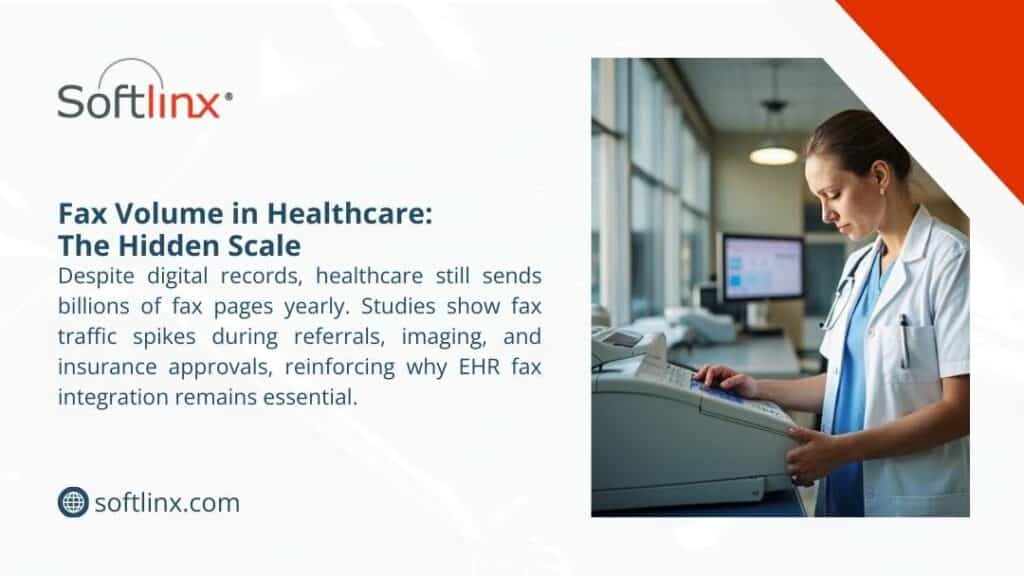
Healthcare has embraced digital transformation, yet fax machines continue to appear in clinical offices worldwide. This is not due to technological resistance, but rather, fragmentation. Electronic health record systems are notorious for their lack of interoperability across organizations, geographies, and vendors. Fax is the only way to send and receive lab results, referrals, authorizations, and patient records, which is why it is so pervasive.
As of 2021, roughly 70% of U.S. hospitals were engaging in all four major domains of interoperable electronic health information exchange: finding, sending, receiving, and integrating patient data with external providers, reflecting substantial digital exchange activity. Similar reliance is observed in European and Asian countries, in particular, in cross-border and independent provider network segments. This explains why the connection of fax to EHR is still a pertinent question in even the most sophisticated healthcare systems.
Traditional fax machines persist because they are legally accepted, widely compatible, and familiar to clinical staff. However, paper-based workflows introduce delays, manual data entry, and a higher risk of human error. Modern healthcare environments now address these challenges by replacing hardware fax machines with digital fax solutions that integrate directly into EHR systems
What Integrated Fax Means in an EHR Environment
Integrated fax refers to the ability to send and receive faxes directly within an electronic health record system or through connected workflows that automatically route documents into patient records. Instead of printing faxes and scanning them back into record EHRs, digital fax services convert incoming transmissions into secure electronic files.
When healthcare teams ask about the meaning of integrated fax, the answer is fax automation. A cloud-based fax service captures incoming faxes as they enter the system, where metadata, bar codes, or optical character recognition classify documents. Those files are then attached to the appropriate electronic health records, minimizing the manual processing of patient data.
This method integrates fax into the electronic health record system rather than treating it as an isolated tool. It also removes the dependency on physical fax machines while maintaining the legal and operational benefits of faxing in healthcare.
How to Connect Fax to EHR Systems Step by Step
How fax is connected to EHR platforms is determined by the technical sophistication of the organization and the functionality of the EHR system. Some contain native fax functionality while others depend on third-party integrations. The table below summarizes the most predominant connection methods used around the world.
| Integration Method | How It Works | Operational Impact |
| Native EHR Fax Integration | Fax features are built directly into the EHR interface | Simple user experience with limited customization |
| Cloud Fax Connector | External fax service routes documents into EHR folders | Strong automation and scalability |
| API-Based Fax Integration | Fax APIs exchange data directly with the EHR | Deep workflow control and custom routing |
Healthcare organizations working with Epic often inquire about how to fax from Epic EMR or how to fax in Epic. In these places, cloud-based fax integrations link Epic workflows with external fax services so healthcare providers can fax and receive faxes from within the EHR interface. Platforms like Epic use document routing that can automatically link faxed lab results or referrals to a patient’s chart. This is possible when the integration is set up optimally.
For organizations that want to achieve greater interoperability, linking fax through cloud fax integration allows EHRs to receive documents electronically, even when faxing is the only option available from external partners. A healthcare-focused cloud fax solution designed for secure document exchange supports this approach seamlessly and at scale.
Security, Compliance, and Patient Data Protection
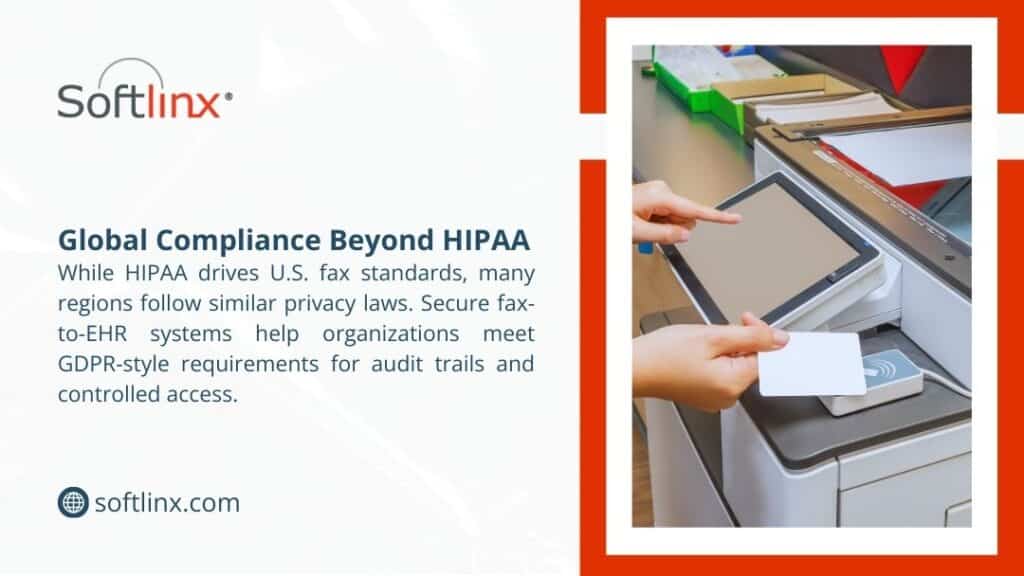
Any discussion about how to connect a fax to EHR must address compliance. Fax remains accepted under HIPAA because it is a point-to-point transmission method. Issues only arise when organizations fail to protect patient data after receipt.
Digital fax solutions designed for health care utilize encryption, access controls, and audit trails to ensure patient data continues to be protected. The U. S. Department of Health and Human Services offers guidance suggesting HIPAA violations occur far more frequently because of the improper handling of faxed documentation rather than the actual transmission of the fax.
Implementing a HIPAA-compliant fax service to replace physical fax machines decreases exposure risks by limiting unauthorized access, preventing lost and misplaced faxed documents, and establishing permanent and secure audit trails of all faxed documents. These issues extend far beyond the United States, where most countries are increasingly adopting health care data protection legislation that is akin to HIPAA.
Common Fax-to-EHR Workflows in Healthcare
Once fax integration is set up, healthcare organizations utilize established and predictable workflows to transfer data into electronic health records. The table below reflects some of the actual implementations that can be found in hospitals, clinics, and specialty practices.
| Workflow Type | Description |
| Referral Intake | Faxed referrals route directly into patient records for review |
| Lab Results | Incoming lab reports are attached to the correct electronic health record |
| Insurance Documentation | Authorization forms are stored securely within patient files |
These workflows minimize the data entry work to be done while guaranteeing that the continuity of care is not interrupted. Clinics that used to rely on staff to physically scan and upload faxes are able to provide documents to their customers fast with little to no indexing errors. Volume production fax systems provide flexibility and adaptability for administrative teams managing a high volume of outgoing faxes.

Choosing the Right Fax Integration for Your EHR
Selecting the right approach to fax integration depends on several factors. Smaller practices may prioritize simplicity, while large health systems often require advanced routing and automation. Organizations with multiple departments or locations benefit from enterprise faxing capabilities that support centralized control.
Healthcare IT teams should also consider whether the fax solution supports future interoperability goals. Cloud-based fax services that offer developer tools and flexible integrations allow organizations to adapt as EHR platforms evolve. An overview of EHR integration capabilities highlights how fax can remain compatible with modern healthcare infrastructure.
Why Cloud-Based Fax Is Replacing Fax Machines
The shift away from physical fax machines reflects broader changes in healthcare operations. Cloud-based fax eliminates maintenance, phone line dependency, and device failures. More importantly, it supports remote work, disaster recovery, and centralized access to patient records.
Industry sources note that digital fax and capture solutions can streamline communication workflows and integrate with electronic records, helping reduce manual steps and support greater operational efficiency in healthcare settings. While fax machines still exist, their role continues to diminish as integrated fax solutions become standard practice.
This evolution explains why healthcare leaders increasingly focus on integrating cloud fax rather than eliminating fax. By connecting fax directly to EHR systems, organizations preserve a trusted communication channel while modernizing workflow efficiency.
Moving Forward with Fax and EHR Integration
Learning how to connect fax and EHR systems is a requirement for scalable healthcare organizations. Healthcare faxing is deeply embedded in the industry, but that does not mean it should be the bottleneck in clinical workflows or compromise data security. Cloud-based, integrated faxing allows healthcare organizations the ability to send and receive secure, processed faxes without workflow slow-downs resulting in less fragmented patient records.
Organizations should assess how their existing fax workflows relate to electronic health records and investigate how such workflows can be automated. A healthcare fax solution that integrates with EHR systems facilitates compliance, operational efficiencies, and sustainable interoperability and addresses global healthcare communications challenges.
For Staff prepared to implement the next generation of their fax infrastructure, investigating secure healthcare cloud faxing systems integrates smoothly and offers an effective solution without interrupting ongoing clinical workflows.